
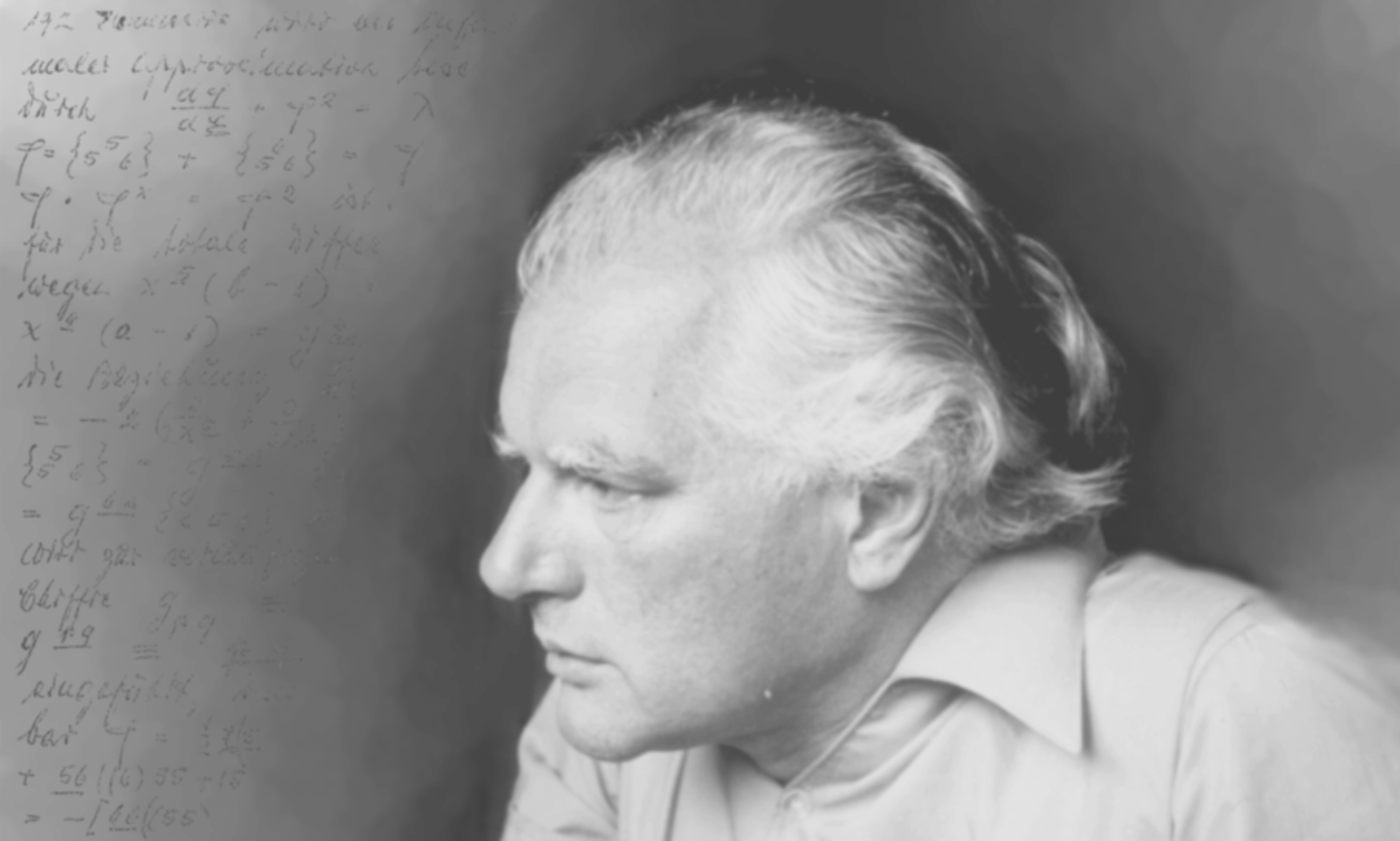
Present work on Heim Theory goes far beyond the mere preservation of historical material. Its aim is to reopen Burkhard Heim’s work in a form that is at once historically responsible, conceptually clear, and mathematically intelligible. This does not mean only locating texts and making them available. It means ordering them, clarifying them, and bringing them into a form in which their internal structure can actually be read.
Heim’s work has come down to us in a difficult state. It is spread across books, lectures, later edited publications, recorded conversations, estate material, and different working versions. In addition, Heim uses a terminology of his own, a highly compressed style, and a mode of presentation in which parts that clearly belong together are not always presented in a way that is immediately transparent to present readers. Current reconstruction therefore means reading, ordering, and reformulating the available material in such a way that its inner coherence becomes visible, without rewriting Heim after the fact.
What this reconstruction is actually concerned with
At the center of this work is, first of all, the clarification of the basic structure of Heim’s theory. This includes the question of how the different phases of his work are related: the early attempts at a unified field description, the multidimensional structure of the material world, the mass formula, and the syntrometric foundational ideas, which, although published only very late, were clearly rooted much earlier and more deeply in Heim’s thinking. Heim is not merely a collection of disconnected ideas. His work contains the claim to a larger internal coherence, and that coherence has to be reconstructed.
A second focus is conceptual clarification. Many of Heim’s key terms are historically layered, unevenly transmitted, or used differently in later presentations. This applies to terms such as metron, selector, televariance, polymetry, syntrix, qualitative dimensions, and the different structural levels of world-description. Reconstruction here means more than simply listing definitions. It means showing the function of these terms within their textual setting and clarifying their place within the corpus as a whole.
A third focus is formal reformulation. Several parts of Heim’s work claim mathematical strictness, but in their present form they are not always developed in the way now expected for testable theoretical work. Reconstruction therefore also includes the task of recasting certain lines of thought into a clearer mathematical language. Within this project, this includes the ordered presentation of coordinate systems, the sharpening of dimension-related structure, the formal treatment of operator-like relations, the reorganization of the mass formula, and the reconstruction of later conceptual frameworks in a more logically explicit form.
Reconstruction within this project
The work documented on this website already moves in several concrete directions.
One major task is the systematic reordering of Heim’s theoretical core. This includes the question of how his coordinate spaces, dimensional levels, and structural terms can be presented consistently without simply flattening their historical peculiarities. Precisely because Heim places different emphases in different phases of his work, careful reconstructive work is required here.
A further task is the mathematical reopening of Heim by means of present-day tools. Certain structures that appear in Heim only in compressed form or in a notation of his own can now be described more precisely using modern differential geometry, bundle theory, operator theory, Hilbert-space formalisms, sheaf structures, or modal-logical methods. These tools are not introduced here in order to modernize Heim artificially, but to bring out more clearly the formal content of his proposals and to render their scope more open to examination.
A third line of work is the careful distinction between Heim himself, later interpretations, and present-day further development. That boundary is indispensable for serious reconstruction. Not everything currently circulating under the label “Heim Theory” goes back directly to Burkhard Heim. For that reason, this project places particular emphasis on distinguishing original work, editorial transmission, later interpretation, and genuinely new extension.
To this must be added the linguistic and international opening of the corpus. A substantial part of Heim’s work is available only in German, and even there it is often difficult to access. Current reconstruction therefore also includes translation, commentary, and introduction to central texts, especially where an English-language presentation is the necessary first step toward broader discussion.
Relation to modern approaches
Current reconstruction is not only retrospective. It also involves comparison. Part of the work consists in asking at which points Heim can be brought into relation with present-day theoretical languages. This concerns, for example, geometrical formulations in terms of bundles and connection structures, operator-based approaches to mass generation, discrete or metronic conceptions of space, semantic and modal-logical extensions, and the question of how Heimian ideas may be brought into dialogue with contemporary particle physics, cosmology, or formal epistemology.
A crucial methodological distinction must be maintained here: not every modern connection already belongs to Heim himself. Reconstruction must not erase that boundary. Where present-day work explains Heim, this must remain visible; where it extends him or supplements him with new formal means, this must also be stated openly. Only in this way can the history of the work be kept distinct from its present development.
Why this work is necessary
Without reconstruction, Heim remains either a merely historical curiosity or a field of free projection. Neither does justice to the work. Anyone who wishes to take Heim seriously must bring the texts into a condition in which they can actually be read, examined, and compared with other theoretical approaches. This requires philological care no less than mathematical precision.
Current reconstruction therefore seeks neither to build a monument nor to proclaim a finished system prematurely. Its task is to work on the conditions under which Burkhard Heim’s work can be understood in its own terms and, where it proves viable, brought into a meaningful contemporary scientific context.

