
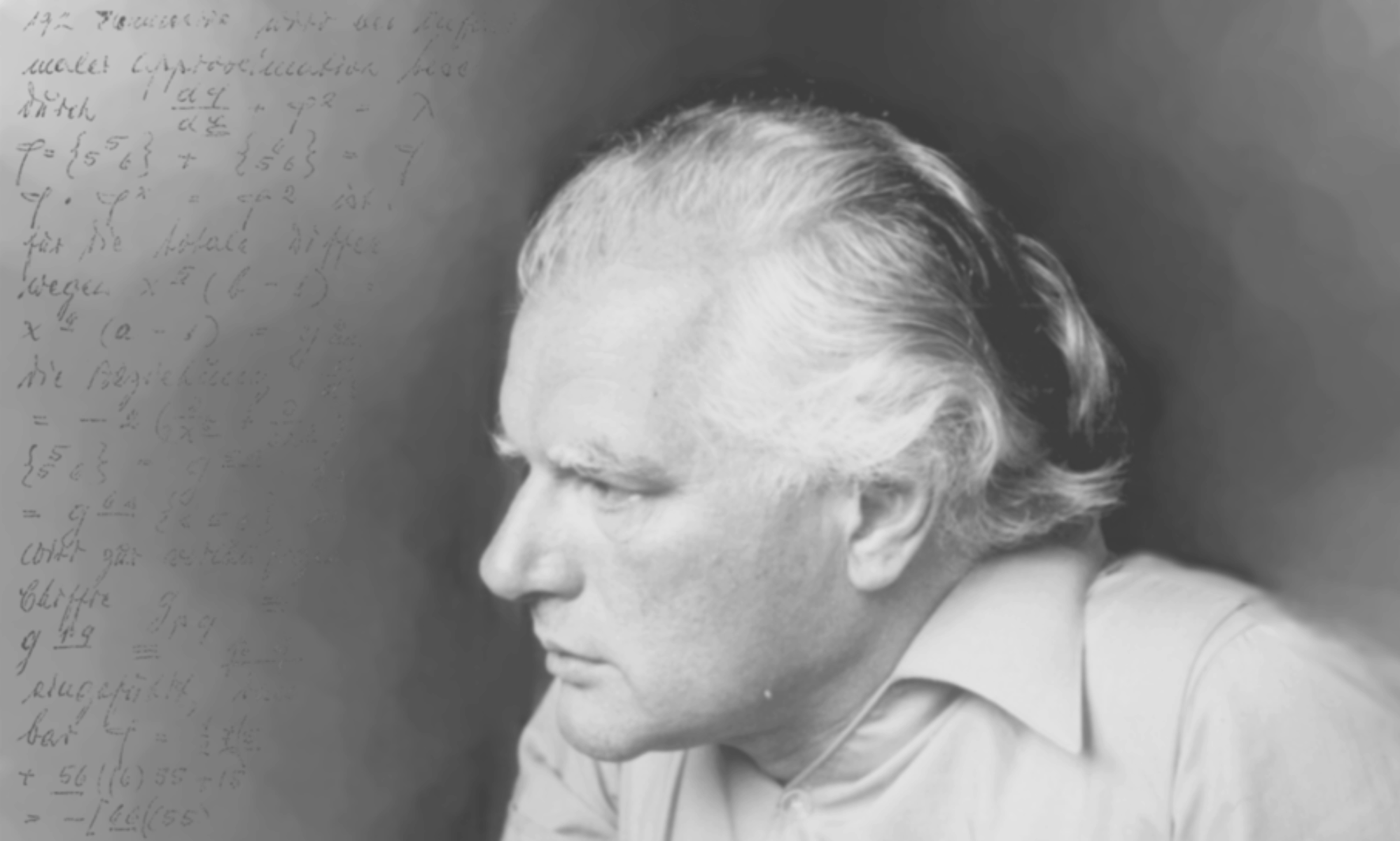
Reconstructing Burkhard Heim’s Work – From Original Sources to Modern Mathematical Theory
Reconstructing Heim Theory involves more than translating historical equations into contemporary notation. It requires making their assumptions explicit, understanding their internal relationships, and formulating their consequences precisely enough to permit independent calculation and critical examination.
Burkhard Heim left an unusually extensive theoretical corpus. His investigations range from the geometrical description of matter and gravitation through metronic quantization and elementary particle physics to Syntrometry as a general framework for structure, order, and organization.
This body of work survives in books, manuscripts, lectures, mathematical studies, and later editions. Its various components were developed over several decades and form an interconnected theoretical undertaking whose complete mathematical reconstruction remains an open task.
Current research therefore pursues a common objective: to preserve Heim’s original theoretical framework in its historical integrity while establishing the foundations for contemporary mathematical analysis and testable scientific development.
During 2025 and 2026, substantial new studies emerged that examine both the principal physical works and Syntrometrische Maximentelezentrik, together with the three volumes of Synmetronik der Welt. These publications form a growing body of reconstruction material whose conclusions require further clarification, verification, and development.
Our guiding principle: Establish the original sources → define concepts and equations precisely → derive mathematical consequences → examine physical meaning and testable predictions.
1. Recovering the Unity of Heim’s Complete Theoretical Work
One of the greatest difficulties in studying Heim Theory is that its underlying ideas are distributed across different periods, publications, and levels of mathematical description.
The two volumes of Elementarstrukturen der Materie develop Heim’s geometrical approach to elementary physical structures. Central elements include gravitation, the six-dimensional structural space, the world metron, polymetry, metronic operations, and selector theory. The objective is to derive a description of discrete material states with their masses, charges, and other physical properties.
Syntrometrische Maximentelezentrik, by contrast, investigates the more general foundations of formal structures and their relationships. Beginning with reflexive abstraction, aspect relativity, and the conditions of predication, it develops a framework involving Syntrices, corporations, Metroplexes, metronic operations, and selection procedures.
The three volumes of Synmetronik der Welt – Part C continue the broader structural investigation toward physical and cosmological questions. Among their subjects are field mechanics, mesobary, aeonic world structures, the world metron, hermetry forms, and complex coupling relationships.
Reconstruction must therefore proceed in two directions at once: identifying the distinct mathematical content of each work while investigating their mutual connections.
In particular, Syntrometry should not simply be treated as a philosophical appendix to Heim’s physics. It represents an attempt to develop a more general methodology of structural description, within which the quantitatively accessible physical world occupies a particular domain of validity.
Sources and further reading: Original Works in the Archive · Syntrometry · Theory – General Overview.
2. Our Reconstruction Method: Sources, Definitions, Derivations, and Verification
The quality of a reconstruction is not determined by how modern its mathematical vocabulary appears, but by whether each essential step is conceptually and formally reproducible.
A. Identifying and Comparing Sources
The first task is to establish precisely what the original texts state. We distinguish historical manuscripts, published editions, later supplements, and mathematical treatments produced by the former Heim working group.
This includes compiling concordances of terminology, equations, and source references. The same structural quantity may appear in different works or periods under altered notation. Conversely, identical terminology should not automatically be taken to imply mathematical equivalence.
B. Defining Mathematical Objects and Assumptions
Every formal reconstruction must specify which mathematical objects are being used, the spaces on which they are defined, and which operations are admissible.
In geometrical approaches, this concerns dimension, signature, metric, connection, tensor structure, and transformation behavior. Metronic models additionally require precise definitions of discrete fundamental quantities, operators, and composition rules.
For Syntrometry, the corresponding questions concern syntax, semantics, structural generation, corporation, selection, and admissible transitions.
C. Independently Reproducing Derivations
An equation has been meaningfully reconstructed only when its premises and derivation are clear.
Critical mathematical steps must therefore be independently checked for dimensional consistency, algebraic properties, boundary conditions, limiting behavior, and possible ambiguities.
Symbolic computation, numerical methods, and computer-assisted proof systems can support this work. They do not replace the need to identify and justify the assumptions being used.
D. Distinguishing Historical Reconstruction from New Hypotheses
In some cases, modern mathematics can directly clarify a relationship already present in Heim’s original formulation. In others, new structures or assumptions must be introduced.
This distinction is essential:
Heim’s original statement is not identical to its modern mathematical interpretation. A subsequent theoretical extension must, in turn, be identified as an independent research contribution.
Only by maintaining this distinction can we determine whether a result genuinely follows from Heim’s theory or from a new model inspired by his work.
3. Reconstructing the Foundations of Heim’s Physics
A substantial part of the present research program concerns the geometrical and mathematical foundations of Heim’s physical theory.
Geometry and Higher-Dimensional Structures
Research examines the mathematical assumptions underlying the six-dimensional space, non-Hermitian field descriptions, polymetry, and the coupling of different metric structures.
The historical development of the framework must be respected. Heim’s original six-dimensional construction, subsequent twelve-dimensional structural descriptions, and later independent extensions should not be treated as mathematically interchangeable.
An important objective is to identify the relevant geometrical invariants and the transformations under which the proposed equations retain their meaning.
Metronic Geometry and Discrete Calculus
Heim’s world metron raises the question of how fundamental geometrical discreteness can be expressed mathematically.
This requires reconstructing metronic difference and summation operators, tensor operations, hyperstructures, and selection conditions. Modern tools such as discrete differential geometry, combinatorial topology, and spectral methods offer possibilities for investigating these problems within new mathematical models.
A major challenge is to establish the relationship between discrete structures and the continuous descriptions used in conventional field theories.
Field Equations and Physical States
Another objective is the precise examination of Heim’s nonlinear eigenvalue problems, field states, and condensation structures.
Research must investigate the mathematical conditions under which particular states are admissible, stable, or coupled to one another. Relationships with General Relativity, quantum mechanics, and particle physics must be derived from the relevant equations rather than inferred from conceptual similarities alone.
Further reading: Mathematics and Logic · Mass Formula and Earlier Calculations · Clarifications by the Former Working Group.
4. Why Mathematical Reconstruction Requires Attention to Detail
A simple example from discrete mathematics illustrates why it is insufficient merely to replace symbols in continuous differential equations with notation associated with a discrete geometry.
For the backward finite difference of a sequence, one may define:
Δfₙ = fₙ − fₙ₋₁
The corresponding product rule is:
Δ(fg)ₙ = fₙ Δgₙ + gₙ Δfₙ − (Δfₙ)(Δgₙ)
Unlike the ordinary Leibniz rule of differential calculus, this expression contains an additional term arising from the finite difference operation.
This elementary example is not a direct reproduction of Heim’s complete metronic calculus. It illustrates a fundamental issue: a discrete mathematical framework requires its own precisely defined rules. If identities from continuous analysis are adopted without checking their validity, errors may arise at the very beginning of a derivation.
Correspondingly, the existence of a continuous limit and the precise relationships between discrete and continuous quantities must be established under explicitly stated assumptions.
Such seemingly minor mathematical distinctions can determine whether an appealing physical idea becomes a coherent and reproducible mathematical theory.
5. Syntrometry as an Independent Mathematical Research Program
Reconstructing Syntrometrische Maximentelezentrik requires extending the mathematical investigation beyond conventional physical field theory.
Heim begins by examining aspect relativity, the conditions of cognition, and the formal relationships between statements and structures. From these investigations he develops a specialized conceptual framework in which Syntrices, Syncolators, Corporators, and Metroplexes represent different forms and levels of structural organization.
A modern reconstruction must establish which mathematical properties can legitimately be assigned to these foundational concepts.
- Syntrix and Syncolator: How can elementary structural configurations and their generation rules be represented formally?
- Corporation and Corporator: Under what conditions can different structures be combined?
- Metroplexes and higher structural orders: How can nested wholes, their dependencies, and transitions be described?
- Selectors and metronic operations: Which rules determine admissible states and structures?
- Aspect relativity and domains of validity: How can different descriptions be compared without obscuring their underlying assumptions?
Contemporary studies investigate possible applications of category theory, sheaf semantics, modal logic, operad theory, and the mathematics of structured hierarchies.
These tools may permit syntrometric relationships to be formulated using precise mathematical concepts and, where appropriate, subjected to formal verification. It must nevertheless be determined whether a particular construction reconstructs a historical definition or introduces an independent modern interpretation.
A particularly important long-term question concerns the relationship between general syntrometric selection and the selection of physical states within Heim’s metronic theory. Whether such a connection can be established in a mathematically defensible form remains an open foundational problem.
Further reading: Syntrometry and Maximentelezentrik · Glossary of Heim Theory.
6. From Physical States to the Organization of Living Systems
Heim’s theoretical program extends beyond elementary particle physics. His later investigations also address biological organization and the relationships among Soma, Bios, Psyche, and Pneuma.
Reconstruction faces a particular challenge here: different domains of reality should neither be treated as completely isolated theoretical systems nor reduced to one mathematical description without justified connections.
Research must therefore investigate the conditions under which different forms and levels of order and organization can be related. Which structural features may be compared across levels? Which characteristics belong specifically to higher forms of organization? Where are quantitative descriptions sufficient, and where might additional conceptual methods be necessary?
Mathematical Syntrometry could provide a broader framework for these questions. Whether this framework can produce precise, empirically accessible statements about living systems remains a subject for further investigation.
Recent studies concerning water, collective physical processes, and the origin of life introduce additional interdisciplinary questions. Their specific physical hypotheses must be evaluated independently of any broader syntrometric interpretation.
Further reading: Biology, Life, and the Origin of Life in Heim Theory · Hedwig Conrad-Martius and Burkhard Heim.
7. New Mathematical Reconstruction Studies, 2025–2026
During 2025 and 2026, a series of substantial research manuscripts became publicly available. They examine different parts of Heim’s complete framework and complement one another in their methods and subject matter.
Syntrometric Foundations and Modern Logic
Unifying Dimensions: Exploring Burkhard Heim’s Syntrometric Vision develops a broad interpretive and systematic introduction to Heim’s syntrometric concepts. It relates the original structural terminology to contemporary questions in logic, epistemology, and complex organization.
A Modernized Syntrometric Logic: Foundations and Applications investigates approaches to more explicit logical formalization, including formal languages, layered semantic structures, modal operators, and proof systems.
Syntrometrische Maximentelezentrik – A Modern Mathematical Reconstruction presents an extensive mathematical reconstruction using categorical logic, sheaf structures, higher algebra, and hierarchical structural models.
The Principal Physical Works in Contemporary Mathematical Form
Burkhard Heim’s Unified Field Theory – Summaries of the MBB Lectures and Metron Calculations combines Heim’s lectures on unified field theory with geometrical and metronic calculations, providing a systematic route into his physical concepts.
Elementarstrukturen der Materie – Volumes I & II: A Modern Mathematical Formalization investigates the geometrical and metronic foundations of Heim’s principal physical volumes and their development toward the description of elementary particles.
Synmetronik der Welt – Part C: Volumes I, II and III – A Modern Mathematical Reconstruction examines the three original Part C manuscripts in a unified mathematical presentation, from field-mechanical foundations to more complex geometrical and cosmological structures.
Discrete Geometry and Comparative Mathematical Research
Effective Metronic Geometrodynamics develops an independent mathematical research approach combining discrete geometry, spectral methods, combinatorial operators, and nonlinear field structures.
Accompanying Chapter-by-Chapter Comparative Analysis studies examine relationships among Heim’s original metronics, newer geometrical models, and Thomas Warmann’s published analytical work.
These studies are modern research contributions, not original writings by Burkhard Heim. They document an active reconstruction program whose mathematical and physical conclusions require further examination. Inclusion in the archive does not, by itself, establish independent verification or scientific peer review.
Explore the Public Research Manuscripts in the Digital Archive
Overview of Modern Developments
8. What Must a Successful Reconstruction Achieve?
Mathematical reconstruction is not an end in itself. Its purpose is to transform a historically difficult theoretical framework into clearly formulated and scientifically assessable statements.
Several kinds of results are required.
Precise foundational definitions: All quantities, operators, and structures must be unambiguously defined, with the assumptions underlying their properties stated explicitly.
Verifiable mathematical derivations: Essential equations and conclusions must be independently reproducible or provable. This includes investigating possible counterexamples and conflicting assumptions.
Relationships with established theories: Where Heim’s framework claims to explain or generalize known physical relationships, the relevant limiting cases and transformations must be demonstrated.
Calculable physical consequences: Mathematical structures acquire physical explanatory content through a justified relationship to observable quantities and processes.
Independent scientific examination: Reproducible calculations, qualified criticism, and meaningful experimental investigations are essential, especially where specific physical predictions are concerned.
Existing reconstruction manuscripts provide working foundations for these tasks. They should not be confused with a completed derivation or empirical confirmation of Heim’s entire theoretical framework.
A central standard is therefore the separation of mathematical consistency, historical fidelity, physical interpretation, and experimental confirmation.
9. International Collaboration and Open Research Tasks
Recovering and critically examining such an extensive body of work requires contributions from several fields of expertise.
Relevant areas include historical textual scholarship, mathematical typesetting, equation concordances, differential geometry, discrete mathematics, algebra, mathematical logic, particle physics, numerical computation, and scientific translation.
Independent verification of existing formulas and models is another important task. Clarifying a definition, identifying an inconsistency, reproducing a calculation, or establishing an exact historical reference can make a concrete contribution to the quality of the overall project.
The international Heim working group developing since 2025 seeks to bring these contributions together and encourage discussion through collaborative exchange, scientific presentations, and thematic Focus Meetings.
The objective is not to promote a closed body of doctrine. Rather, it is to build an open scientific environment in which original sources remain accessible, new models are presented transparently, and critical questions are explicitly welcome.
Community and Heim Working Group
10. Further Reading and Essential Sources
Theory – Foundations and Overall Structure
An introduction to Heim’s physics, metronics, higher-dimensional structures, and Syntrometry.
Research – Current Fields and Open Problems
The wider research program, including scientific publications, current areas of investigation, and opportunities for collaboration.
Historical lines of development, former research groups, peer-reviewed publications, and modern mathematical reconstruction studies.
The foundations of Heim’s general structural theory and recent approaches to its mathematical formalization.
The Former Heim Theory Working Group
Historical and computational investigations undertaken by research groups in the early 2000s.
Chronology of Life, Work, and Further Development
The development of Heim Theory from its early foundations through research contributions in 2026.
Archive – Original Works, Manuscripts, and Modern Research
The central collection of historical sources, later studies, scientific publications, and contemporary reconstruction manuscripts.
The Objective of Reconstruction
We seek neither to reduce Heim Theory to a handful of familiar results nor to replace it with contemporary interpretations. Its geometrical, physical, syntrometric, and broader structural foundations must instead be examined as parts of an interconnected undertaking.
The essential task is to derive mathematically precise statements from historical sources, reproduce their consequences, and independently evaluate their physical validity.
In this way, preserving an exceptional theoretical legacy can become the foundation of a sustainable, long-term research program.
Editorial status: October 2026. Reconstruction materials and research developments are being expanded and updated continuously.

