
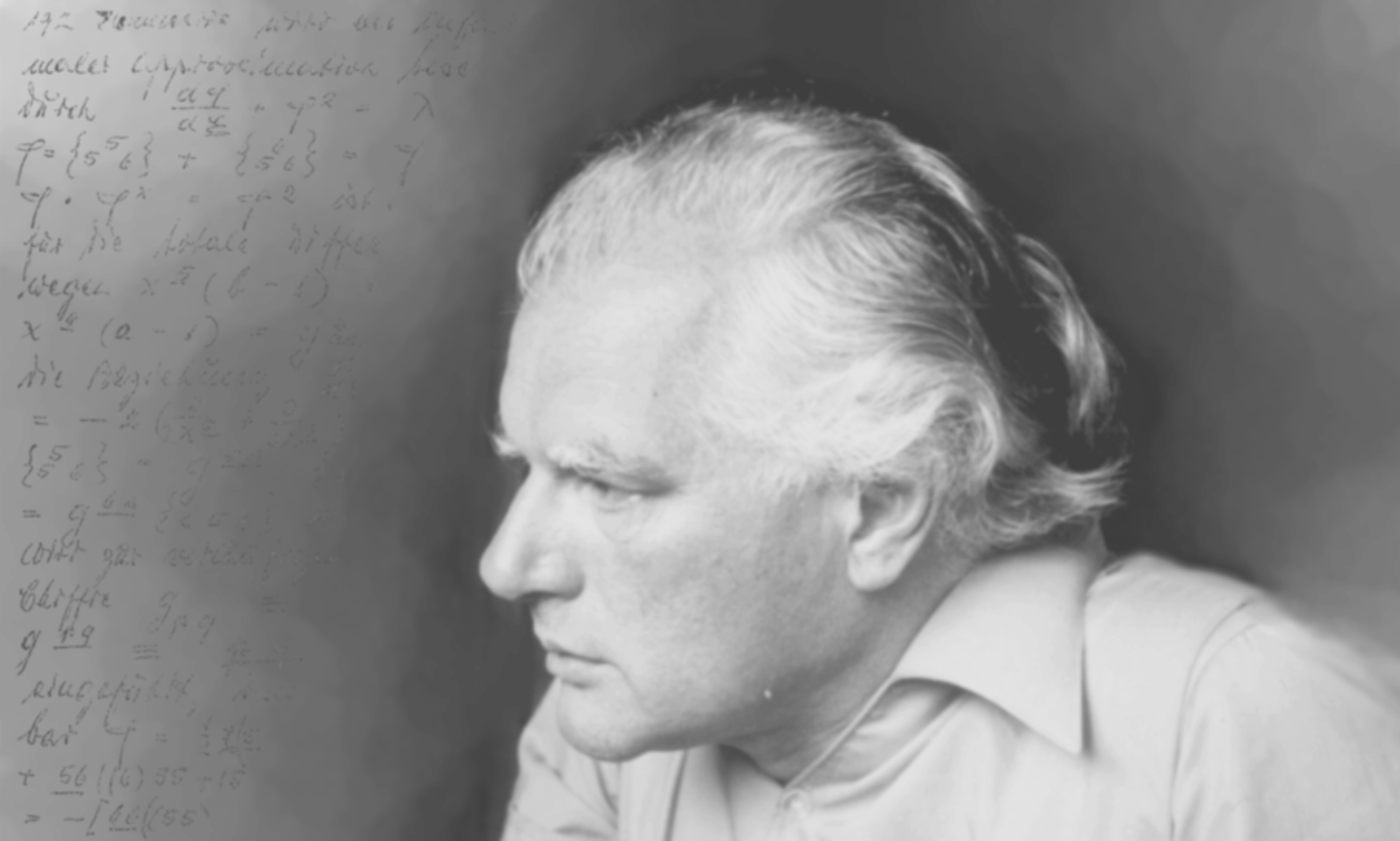
Anyone who studies Burkhard Heim in some depth eventually reaches a question that goes beyond ordinary physics. Is it enough to describe nature in terms of objects, quantities, and interactions, or must one go deeper and ask about the forms, distinctions, and logical conditions under which anything can appear at all as object, structure, or world? It is precisely at this point that Heim touches another unusual line of thought from the twentieth century: George Spencer-Brown’s Laws of Form. Around that work there now exists a wider intellectual milieu, including conferences, the Spencer-Brown Society, the journal Distinction: Journal of Form, and the ongoing discussion group lawsofform@groups.io. Within this broader setting, a distinct line of work has emerged that reads Laws of Form together with Heim Theory.
Spencer-Brown’s point of departure is radically simple. What comes first is not the finished object, but the drawn distinction. Form begins with a boundary: a marked side set off from an unmarked side. From this elementary act Spencer-Brown develops a calculus of indication, distinction, and re-entry. The overlap with Heim begins here. Heim, too, does not ground reality in the mathematical point. His metron is not a point-like ultimate constituent, but a smallest area; from it follows the idea of a metronic lattice and the claim that ordinary infinitesimal analysis is not fully adequate to the deep structure of the physical world. In both cases, the fundamental level is not built from already given substances, but from elementary structure: boundary, form, area, articulation.
This is more than a loose analogy. In Heim’s framework, matter is not a separate stuff inserted into space; it is a structured deformation of an underlying metronic order. The unperturbed lattice signifies emptiness, while local distortions of that lattice yield particle structure, mass, and physical form. That makes Heim’s theory deeply “form-first” in a literal sense: first the internal structure, then the interactions. Lyle Anderson emphasizes exactly this point in his own public work on Heim and Laws of Form, where he explicitly describes Heim’s approach as form-first and treats Heim’s extended quantum field theory as something that may be read through a Spencer-Brownian logic of distinction and structure.
The overlap becomes even stronger in Heim’s later work. In the Syntrometrische Maximentelezentrik, Heim no longer seeks only a theory of elementary particles. He explicitly searches for a formal method that can operate across different logical systems. Syntrometry is introduced there as a general conceptual procedure grounded in aspect-systems, subjective aspects, quantors, system-generators, and controlled transformations of meaning across distinct logical domains. In other words, Heim is no longer asking only how the physical world is built, but also how form, statement, and intelligibility themselves can be organized on a higher level. This is where the encounter with Spencer-Brown becomes especially fertile. Laws of Form begins from distinction and asks how indication, logic, and observation arise from it. Heim, in Syntrometry, asks how structured worlds of statement can be generated, related, and made formally tractable across aspect-relative systems. Both projects move toward a deeper layer beneath ordinary formalism: a generative level at which form and intelligibility are produced rather than merely described.
A further point of contact lies in the role of the observer. Spencer-Brown’s distinction is never merely an inert mark; it already implies indication, perspective, and the asymmetry introduced by drawing a boundary. Heim, along a different path, develops a theory of subjective aspects and aspect-relativity in which every formal description is tied to an aspect-system, yet without collapsing truth into arbitrariness. What matters in both cases is that form is inseparable from standpoint. The world is not approached as a neutral heap of facts, but as something articulated through lawful modes of distinction. This is one of the deepest reasons why Laws of Form and Heim belong in the same conversation.
This line of work is now being pursued explicitly within the contemporary Laws of Form milieu. A key public marker was Lyle Allen Anderson’s LoF22 presentation, “Laws of Form and Burkhard Heim’s Theory of Everything.” The conference description states the claim directly: Heim’s theory is presented there as resting on four axioms, each of which can be traced back to Laws of Form. Anderson’s wider series of posts and papers continues the same direction, linking Heim not only to form and distinction in the narrow sense, but also to cosmology, Syntrometry, artificial intelligence, and the question of how a formal logic of distinction might pass over into a physical and semantic theory of world-structure. One focal thread in this ongoing exchange is message #4787 in the lawsofform group.
What is at stake in this research strand is therefore not merely a comparison between two eccentric thinkers. The more serious question is whether Heim can be read as a genuine theory of form in the strongest sense: not only a theory of particles or masses, but a theory in which geometry, quantization, observation, semantics, and logical articulation belong to one deeper order. Read in that light, Heim stands much closer to Spencer-Brown than one might first expect. Spencer-Brown asks how form begins. Heim asks how world-structure, physical reality, and eventually meaning-bearing aspect-systems are generated from deeper formal conditions. The intersection between the two is thus not superficial. It lies at the level where physics approaches metalogic, and metalogic again seeks embodiment in the structure of the world.
The work especially of Lyle Anderson is ongoing in that regard.
Further links:
Laws of Form group:
https://groups.io/g/lawsofform
Main Heim-related working thread:
https://groups.io/g/lawsofform/message/4787
LoF22 talk by Lyle Anderson:
https://lof50.com/lof22-day3
Lyle Anderson paper:
https://www.academia.edu/107803348/THE_LAWS_OF_FORM_and_HEIMS_THEORY_OF_EVERYTHING

