
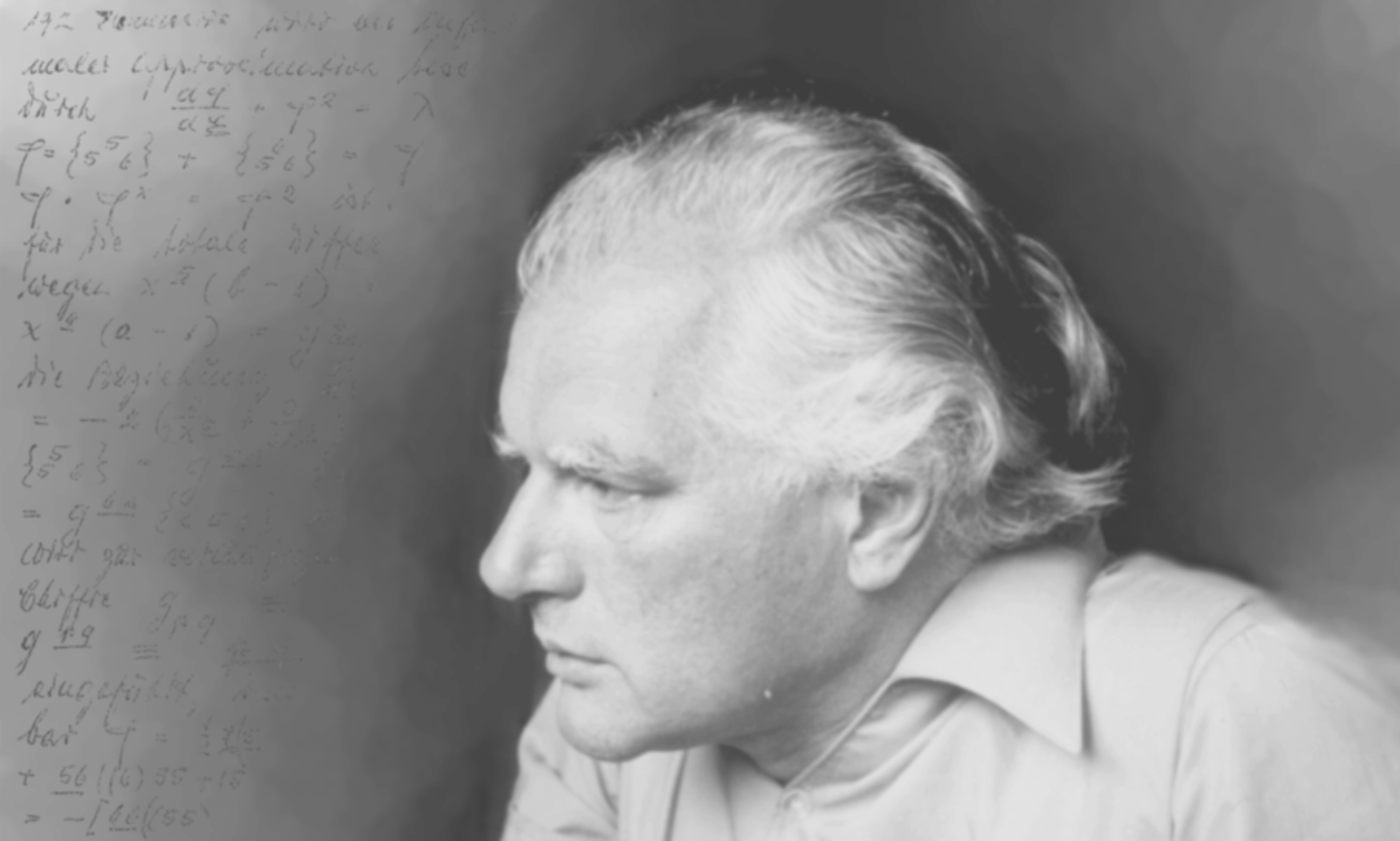
The Philosophical Depth Dimension of Burkhard Heim’s Theory
Hedwig Conrad-Martius (1888–1966) was one of the important, though still comparatively little-known, figures of early realist phenomenology. She studied in Rostock, Freiburg, Munich, and Göttingen, and received her doctorate in Munich in 1912. As a woman, she faced substantial structural barriers within the German university system of her time: Munich offered her no path to habilitation, a further habilitation attempt in Tübingen failed in 1931, and her academic career remained blocked for many years by the conditions of the period. Under National Socialism this situation became even harsher; in 1935 she was excluded from the Reichsschrifttumskammer, and her possibilities for publication were severely restricted. After 1945, however, she returned to university life: in 1949 she became a lecturer in philosophy of nature in Munich, and in 1955 an honorary professor of philosophy there. In this later phase she was once again highly productive, continuing in lectures and writings to work on the major themes of her thought — being, space, time, the constitution of nature, evolution, and life. Her work shows the depth with which she pursued the question of reality, and that is precisely why it is so valuable for understanding Burkhard Heim.
Anyone who reads Burkhard Heim only as a theorist of additional dimensions, particle structures, and field-like world models misses something essential. From the beginning, more was at stake in his work than an extension of the physical toolkit. His work asks what reality actually is, how it is structured, how manifest nature emerges from deeper orders, and why the physical world cannot be the final horizon of being. At exactly this point, Hedwig Conrad-Martius becomes one of the most important philosophical reference figures for understanding Heim’s theory. Her writings do not provide a physical formalism in Heim’s sense, but they articulate with great conceptual precision precisely those ontological problems that Heim takes up again in mathematical and cosmological form: reality, stratification of being, the transphysical ground of space and time, entelechial organization, the self-construction of nature, and the irreducibility of life.
Conrad-Martius and Heim developed their central ideas independently of one another. Their actual meeting is therefore all the more illuminating. Gerda Heim reports that Burkhard Heim contacted Hedwig Conrad-Martius in 1958, that she immediately received him, and that the conversation quickly turned to the fact that she was able to explain, in epistemological terms, how his physical idea fit into an ontologically expanded system of thought that went beyond the framework of classical physics. This remark is brief, but of considerable importance. It shows that the proximity between the two was not constructed retrospectively, but was already experienced in personal exchange as something objectively real.
Their decisive common starting point is a rigorous realism. Conrad-Martius opposes every view in which the world appears primarily as a correlate of consciousness, subjectivity, or mere cognitive performance. In systematic presentations of her thought, it is expressly emphasized that real existence is not exclusively a matter of the knowing subject, but that the world possesses a reality independent of consciousness. For her, real being is something that truly is, something that can itself sustain its existence and essence and stands in its own potency with respect to its being and suchness. The real is therefore not understood as a logical posit, not as a mere phenomenon for a subject, and not as an abstract thought-thing, but as self-supporting reality. This attitude is equally fundamental for Heim. His theory does not merely aim to provide models of what is observable, but to grasp structures of the world itself. For that reason Heim explicitly states that the physically describable world is only the quantifiable shadow of the real world.
Being
In Das Sein (Being), Conrad-Martius develops the fundamental question that runs through all her thought: what does it actually mean that something is real? The book is not aimed at a mere classification of concepts, but at uncovering the inner structure of real being. Secondary treatments of her work emphasize that in Das Sein she unfolds the basic constituents of real being and determines reality as a self-grounded capacity for its own being. In doing so, she distinguishes different forms of being, especially the hypokeimenal form of being of hyletic substance and the archonal form of being of pneumatic substance. The real is therefore not homogeneous. It possesses an internal stratification and different modes of self-realization.
This is precisely where the affinity with Heim becomes especially illuminating. Heim likewise does not think the world in one dimension only. In his later presentations, experiential being appears in a fourfold contouring of physis, bios, psyche, and pneuma. These are not simply additive levels, but hierarchically nested orders in which higher lawful structures presuppose the lower ones without being reducible to them. This is where Heim gains a conceptual background: if reality itself is stratified, then it becomes meaningful to speak of domains that go beyond the physical without thereby becoming unreal. Das Sein does not supply a Heimian physics, but it does provide the ontological language in which such a layered conception of reality becomes intelligible.
Space
In Der Raum (Space), Conrad-Martius addresses a theme that also stands at the center of Heim’s worldview: space is not simply a container in which things occur. The structure of the book already shows how far her approach reaches. Its table of contents moves from metric continuous space through apeiron and peiron to quantized space, the emergence of corporeal entities, and elementary particles as an ontological interpretation of quantum theory. Space is investigated here not only geometrically, but ontologically and cosmologically.
Of particular importance is Conrad-Martius’ thesis that metric space does not stand independently on its own, but appears as a formal dimension of matter. In systematic expositions of her thought one finds the explicit formulation that insofar as matter becomes or is, space likewise becomes or is as its formal dimension. Physical, measurable space is therefore not ultimate, but an expression of a deeper event of positing. If matter is subtracted from space, what remains is a boundless and measureless spatiality that Conrad-Martius determines as apeiric space or non-space. This apeiric space is not the physical cosmos itself, but the condition of possibility of metric space.
For Heim, exactly this shift is decisive. In his work as well, space-time is not the world itself, but only a subspace within a more comprehensive structure. In Mensch und Welt (Man and World), this is stated explicitly: space-time is not the world, but merely the subspace of six-dimensional hyperspace. Heim therefore extends physical space not out of mathematical playfulness, but because manifest space-time structures point toward a deeper background. Here both lines of thought meet directly. Conrad-Martius works out the ontological priority of a transphysical space; Heim formalizes an expanded world-structure in which space-time is only one partial region. The fact that Conrad-Martius in Der Raum even treats quantized space and the ontological interpretation of quantum theory makes the objective proximity even clearer.
Time
In Die Zeit (Time), Conrad-Martius deepens the same movement at the level of the problem of time. The chapter headings alone show that she does not understand time as a merely linear continuum: real point of presence, discontinuous foundation of time, aeonic world-time, supraphysical space-time, and discontinuous acts of actualization. For her, time appears as a real process of actualization and not merely as a subjective form of intuition or a neutral axis of measurement.
The systematic interpretation of her work sharpens this point further. There it is stated that the becoming of being does not take place merely on the surface of spatio-temporal reality, but is an ontic process of being that arises from real grounds of possibility that precede nature and ground it transphysically. Accordingly, Conrad-Martius distinguishes between physical, measurable time and a transphysical over-time as its condition. Beyond this, she speaks of an aeonic time that surpasses both the being of the perishable and measurable time itself, and that is categorially connected with space-time. Time is therefore internally stratified in her thought: empirical time, transphysical over-time, aeonic world-time.
For understanding Heim, this is of extraordinary importance. Heim introduces with and two hidden world-dimensions that he explicitly interprets as the entelechial and the aeonic coordinate respectively. In Mensch und Welt, Heim himself says that Conrad-Martius suggested to him in a personal conversation that he rethink the Aristotelian concept of entelechy and interpret as the entelechial coordinate of the world and as the aeonic world-coordinate. He further states there that above the bundle of physical space-time lines lies an entelechial structure-field that is continuously re-actualized out of the aeonic world-dimension and steered in the direction of its actualization. The objective connection between Conrad-Martius’ ontology of time and Heim is therefore especially direct: for both, time is not merely a measurable quantity, but the expression of a deeper process of actualization.
The Self-Construction of Nature
Conrad-Martius and Heim touch most directly in the domain of the philosophy of nature and life. Der Selbstaufbau der Natur. Entelechien und Energien (The Self-Construction of Nature: Entelechies and Energies) is not merely a biological book, but a comprehensive ontology of the becoming of form. The chapters already indicate the direction: entelechy as a holistic, order-giving factor; formative processes as field-like performances of wholeness; formative potencies; morphogenesis; differentiation potency; organizational potency; formative entelechy; essential entelechy; and the inner body. Nature is not thought here as an aggregate of finished objects, but as a process of self-positing, form-generation, and organization.
In modern presentations of her approach, the core is formulated succinctly: the title points to the idea that natural substances arise in a process of self-construction; not only organic but also inorganic substances emerge through self-positing. Conrad-Martius therefore explicitly calls nature self-creative. She distinguishes between essential entelechy and formative entelechy. Essential entelechy presses toward realization, while the formative entelechies stand in a transphysical domain and are teleologically directed toward determinate forms of material manifestation. Matter thus appears not as absolutely primary, but as the result of a deeper ordering context of realization that is not purely physical.
Her conception of the living is especially important. Conrad-Martius emphasizes that life is not merely formed nature, but self-forming nature. In secondary presentations of her work, her statement is highlighted that not only formation but self-formation constitutes life. Organization is for her not an external arrangement, but an internally articulated order-whole realized by objective powers of actualization and actuality-ready energies. Her description of organismic form as an extensive manifold of form borne by imagoidal prefigurations and limb-potencies belongs to the densest philosophical accounts of nature in the twentieth century.
This is one of the strongest resonances with Heim. Heim does not describe biological structures as mere chemical complexity, but as organized wholes whose understanding requires looking beyond the physical. In Mensch und Welt, Heim states that bios comprises the totality of biological modes of behavior, bound up with active self-formation, and that these are steered from hyperspace. In Der Elementarprozess des Lebens (The Elementary Process of Life), Heim even explicitly says that organic structures are entelechially stratified complexes of action that are continuously re-actualized in time. This is not a merely accidental verbal resemblance. For both, what stands at the center is that life possesses form, organization, and actualization that cannot be derived from physical mechanism alone.
Why Conrad-Martius is so illuminating for Heim
Conrad-Martius brings several basic commitments into view without which Heim is easily misunderstood. First, for both of them reality is more than what can be measured. Second, the physical world is not the final level of the real. Third, space and time rest upon deeper conditions of possibility. Fourth, organization is not merely the result of accidental material distribution, but the expression of an ordering dynamic. Fifth, the living possesses its own lawful structure. These points appear in Conrad-Martius in ontological and natural-philosophical form, and reappear in Heim in structural-theoretical, cosmological, and partly mathematical form.
It is especially revealing that Heim himself explicitly adopts concepts that are central in Conrad-Martius’ thought. The interpretation of as the entelechial dimension and as the aeonic dimension is directly connected in Heim’s own text with a conversation with Conrad-Martius. For Heim, physis is only the quantifiable shadow of the real world; bios, psyche, and pneuma require looking behind that shadow. This is precisely the point at which Conrad-Martius becomes philosophically indispensable. She shows what it means ontologically that measurable space is not ultimate, that empirical time rests on deeper acts of actualization, that matter emerges from ordering processes, and that life forms a real layer of the world that cannot be exhausted mechanically.
Conrad-Martius does not replace Heim. She gives no mass formulas, no hermetry, no polymetric field structure. But she clarifies the ontological horizon within which a theory like Heim’s stands at all. Whoever sees only mathematics in Heim easily overlooks the reality-claim of his project. Whoever reads Conrad-Martius alongside him sees more clearly that Heim is concerned with a stratified world in which manifest natural processes emerge from deeper orders of reality. Only then does it become fully intelligible why Heim speaks beyond physis of bios, psyche, and pneuma, why he uses entelechy and aeon not merely metaphorically but structurally, and why his theory presses from the beginning beyond the boundaries of a purely classical physics.
Hedwig Conrad-Martius is therefore not merely interesting for the understanding of Burkhard Heim, but fundamental. Her four major works, Das Sein, Der Raum, Die Zeit, and Der Selbstaufbau der Natur, open a philosophical access to exactly those questions on which Heim works physically and cosmologically. In her work, reality, space, time, life, and organization are uncovered ontologically. In Heim, the same problem-fields are drawn into a comprehensive theory of the structure of the world. Only when both are thought together does the full reach of Heim’s project become visible.
ENGLISH
Further Reading on Hedwig Conrad-Martius
Deutsche Biographie – Hedwig Conrad-Martius
https://www.deutsche-biographie.de/gnd119110679.html
A reliable biographical starting point with concise information on her life, intellectual context, and further bibliography.
History of Women Philosophers and Scientists – Hedwig Conrad-Martius
https://historyofwomenphilosophers.org/project/directory-of-women-philosophers/conrad-martius-hedwig-1888-1966/
A compact but strong introduction to Conrad-Martius as a major figure in realistic phenomenology and ontology.
Conrad-Martiusiana – Manuscripts and Archival Material
https://historyofwomenphilosophers.org/project/women-in-early-phenomenology/conrad-martiusiana/a-manuscripts/
Especially useful for deeper work on unpublished texts, manuscripts, archival holdings, and editorial notes.
Bavarian State Library – Literary Estates
https://www.bsb-muenchen.de/sammlungen/handschriften/personen/nachlaesse/
An archival access point for estate materials, useful for studying the physical transmission and research history of her work.
Der Ursprung des Menschen (PDF)
https://philosophisches-jahrbuch.de/wp-content/uploads/2018/12/PJ60_S122-138_Conrad-Martius_Der-Ursprung-des-Menschen.pdf
An openly accessible primary text by Conrad-Martius on anthropology, natural history, and metaphysical questions concerning the human being.
Abstammungsproblematik (PDF)
https://philosophisches-jahrbuch.de/wp-content/uploads/2018/12/PJ60_S338-341_Conrad-Martius_Abstammungsproblematik.pdf
A short but illuminating text on descent and development at the boundary between science and metaphysics.
Metaphysical Conversations and Phenomenological Essays – Preview (PDF)
https://api.pageplace.de/preview/DT0400.9783110763096_A48311351/preview-9783110763096_A48311351.pdf
A useful English-language entry point with table of contents, editorial framing, and sample pages from a modern edition.
Metaphysical Conversations and Phenomenological Essays – Preview (PDF)
https://api.pageplace.de/preview/DT0400.9783110763096_A48311351/preview-9783110763096_A48311351.pdf
A useful English-language entry point with table of contents, editorial framing, and sample pages from a modern edition.

