
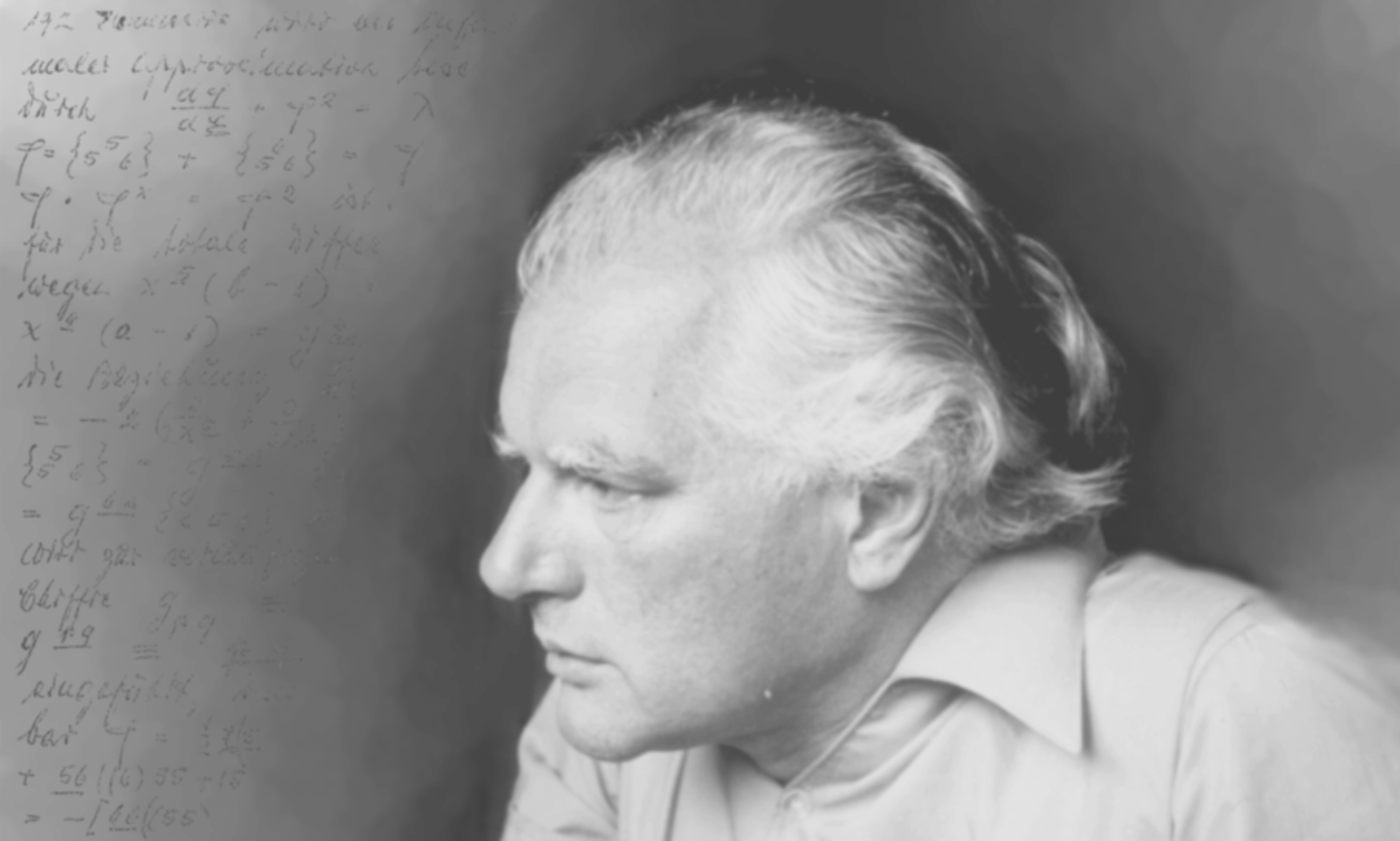
This page offers an overview of more recent works, projects, and lines of development that have emerged from engagement with Burkhard Heim. It therefore does not belong to Burkhard Heim’s historical corpus itself, but to its later interpretation, reconstruction, clarification, and continuation. The overview is not complete and will be expanded over time. If important works, persons, or projects are missing here, we would be grateful for a note at info@heim-theory.com.
Modern work on Heim does not proceed in a single direction. Since the 1990s, several lines have emerged that differ significantly in aim, method, and proximity to Heim’s original work. Some have mainly preserved and made material accessible. Others have tried to recast parts of the theory in a more precise formal language. Still others have taken up selected Heimian ideas and developed them into an independent program.
Working groups, editions, and early editorial development
The first modern line is the editorial and interpretive work through which a large part of Heim-related material remained accessible at all. This includes above all the older Arbeitskreis Heim-Theorie around Illobrand von Ludwiger, the later provision of texts and study aids on Protosimplex by Olaf Posdzech, and the broader mediation of Heim’s work in the context of IGAAP. Protosimplex describes itself as an internet project on Burkhard Heim that has existed since 1998 and provides biographies, bibliographies, downloads, study aids for Elementarstrukturen der Materie, as well as audio and video material. IGAAP has likewise maintained Heim as a distinct topic for years and offers, among other things, a longer introduction under the title “Die Einheitliche Quantenfeldtheorie von Burkhard Heim.”
This older line of work was not completely uniform; different emphases were already visible within the Heim milieu itself. Its main weight, however, lay not in the development of a new formal theory of its own, but in collecting, preserving, publishing, explaining, and offering first systematic interpretations. Without this work, many of the materials on which present-day reconstructions now depend would scarcely be accessible. A part of the present website and archive work therefore stands in direct continuity with this older phase of editorial development.
A new Heim working group since 2025
Alongside these older contexts, a new Heim working group has been growing again since 2025. The Community page of this website explicitly refers to a more focused Heim working group intended to coordinate source material, theoretical reconstruction, historical research, translations, editorial work, and future projects; the Google Group is named there as a central organizational tool. This newer line aims more strongly than earlier individual initiatives to bring scattered work together again, to build international contacts, and to coordinate editorial, mathematical, and experimental interests within one common framework.
The Dröscher / Häuser line
Clearly distinct from the editorial line is the development associated with Walter Dröscher and Jochem Häuser. It begins from Heim, but follows a markedly independent direction, especially in the area of additional dimensions, gravitophotonic fields, and propulsion-related applications. This line became publicly visible above all through works such as “Guidelines for a Space Propulsion Device Based on Heim’s Quantum Theory” (2004) and “Heim Quantum Theory for Space Propulsion Physics” (2005). Within the framework of this website, this direction should therefore not appear as Burkhard Heim’s original work itself, but as an independent further development that adopts certain key Heimian ideas while pursuing a distinct technical program.
Peer-reviewed physical continuation: Thomas Warmann
A different line is being pursued by Thomas Warmann. Here the main concern is not editorial preservation or propulsion-oriented extension, but the effort to bring Heim into an explicitly peer-reviewed physical discussion. Publicly visible examples include “The generation of mass in a non-linear field theory” (2022) and “The Standard Model and quantum state reduction from Heim’s field theory” (2023), along with further newer titles and a corrigendum from 2025. This line is especially important because it marks an attempt to treat Heim not merely historically or popular-scientifically, but to restate parts of his theoretical claim in a form that can enter formal contemporary discussion.
At the same time, it should be noted that these works have so far addressed only part of Heim’s total corpus. Their main focus at present lies on field theory, mass generation, and connections to parts of the Standard Model. The Syntrometrische Maximentelezentrik, and with it Heim’s later methodological and logical expansion, has not yet been taken up within this peer-reviewed line. For that reason, syntrometric work remains of particular importance for any fuller picture of Heim Theory.
Syntrometric development and reformulation:
A distinct and especially important line in the present situation is the work of an currently anonymous researcher on the Syntrometrische Maximentelezentrik. His works are already listed separately in this website’s archive, including “Unifying Dimensions: Exploring Burkhard Heim’s Syntrometric Vision” and “A Modernized Syntrometric Logic: Foundations and Applications”; these publications are also publicly visible outside the website. This line is so important because it addresses precisely that part of Heim’s corpus which has so far scarcely been treated in systematic form within later physical developments.
Comparative work: Heim and Laws of Form
There are also works that neither primarily edit Heim nor directly reconstruct him physically, but instead relate him to other formal and epistemological approaches. An important example is Lyle Allen Anderson III and his presentation “Laws of Form and Burkhard Heim’s Theory of Everything” at the LoF Conference 2022. The central question here is whether deeper structural or logical correspondences can be identified between Heim and George Spencer-Brown’s Laws of Form. Such work belongs to the field of comparative and interpretive bridge-building.
Reconstructive continuation: Joel Michalowitz
A further line is the present work of Joel Michalowitz. The aim here is to recast central structures of Heim Theory into a language that can work more precisely with present mathematical and theoretical tools. This includes, in particular, efforts to make Heim newly readable in terms of fiber bundles, holonomy, sheaf and cohomological structures, modern operator reconstructions, and other geometrical formulations, without excluding the syntrometric expansion. This line is still in an early stage and is not yet peer-reviewed, but it belongs among the most systematically ambitious attempts to not merely interpret Heim, but to translate him into a contemporary formal language.
Experimental perspective as the decisive test
A further focus of the new working group lies in the question of which statements of Heim Theory can be formulated in experimentally testable form at all. For physical theories, experimental verification remains the decisive test. Precisely because Heim moves between geometrical foundational theory, mass formula, cosmological claims, and later expansions, it is essential to identify those parts of the work that can be sharpened into clear and testable statements. Current work therefore aims not only at conceptual or mathematical reconstruction, but explicitly at the formulation of experimentally relevant questions.
Present situation
Modern work on Burkhard Heim is now more diverse than it was a few years ago. There is an older editorial and interpretive tradition, independent developments such as the Dröscher / Häuser direction, first peer-reviewed physical work, syntrometric reformulations, comparative bridge-building, and new reconstructive approaches within the working group that has been growing since 2025. This overview therefore remains intentionally open. It is not meant to provide a closed canon, but a realistic picture of the present field.

