
Spaceflight Concept and Public Perception
Burkhard Heim did not develop his theory purely as an abstract model of physics, but from the beginning also with the question of possible technical applications. At the center of this effort was the idea that his field theory might allow for a fundamentally new principle of propulsion.
Already in the early 1950s, Heim formulated the concept of so-called dynamic contrabary. Unlike conventional rocket propulsion, which depends on the expulsion of reaction mass, this approach was intended to rely on a direct interaction of fields. The goal was a system capable of generating a controlled force effect and thereby enabling motion within a gravitational field.
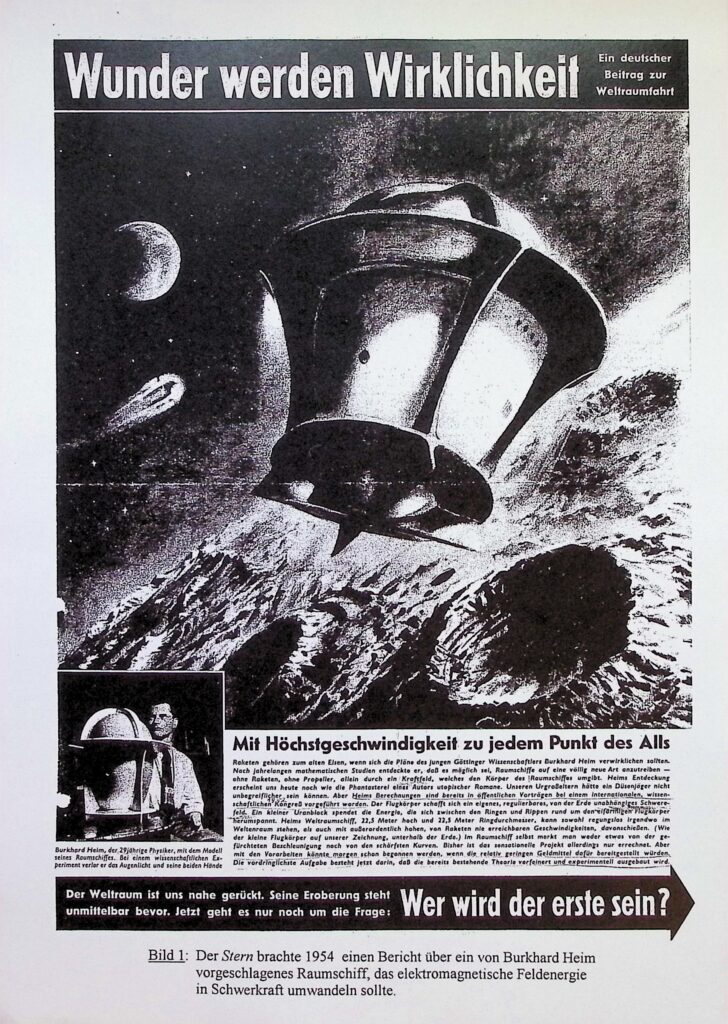
These ideas attracted public attention at an early stage. In particular, an article published in 1955 in the magazine Stern (“Can gravity be neutralized?”) brought Heim to a wider audience beyond specialized scientific circles. In the following years, additional newspapers and magazines — especially in connection with his 1959 lecture in Rome — took up these topics and often presented them in the context of a possible “space drive.”
It is important to distinguish between public presentation and the actual state of research: media reports frequently used simplified or sensational formulations, whereas Heim himself treated the concept as a physical principle that still required verification.
The experimental program on contrabary was intended precisely for this purpose:
not only to further develop the theoretical foundations, but to investigate whether such a mechanism could be demonstrated in the laboratory, or at least realized in a preliminary form.
Foundation of the Institute
The experimental phase of Burkhard Heim’s work began in the mid-1950s directly following his theoretical developments on gravitation and field structure.
Already in 1957, the first concrete experiments for the detection of a “contrabary effect” were carried out .
In order to systematically continue this work:
- an independent research institute was founded in 1958
- located in Northeim
This institute initially bore the name:
- “Research Institute for Dynamic Contrabary and Astronautics e.V.”
and was later renamed:
- “German Research Institute for Field Physics e.V.” (1960)
On April 12, 1960, it was officially recognized as a charitable scientific institution .
Structure and Organization
The experimental work was not centralized but distributed across several groups:
- Northeim: central laboratory and assembly of the main apparatus
- Hamburg: development of high-frequency and radar components
- Hannover: development of measurement systems (especially gravimeters)
This division led to significant coordination problems, since essential components were often not available at the required time .
Objective of the Experiments
The goal of the so-called contrabary experiments was:
the conversion of electromagnetic energy (in particular microwaves)
into a directly measurable force effect (gravitational or inertial-like effects)
More concretely, an effect was to be generated in which:
- a test body changes its weight periodically
- as a result of a novel field process
Experimental Setup (“Contrabator”)
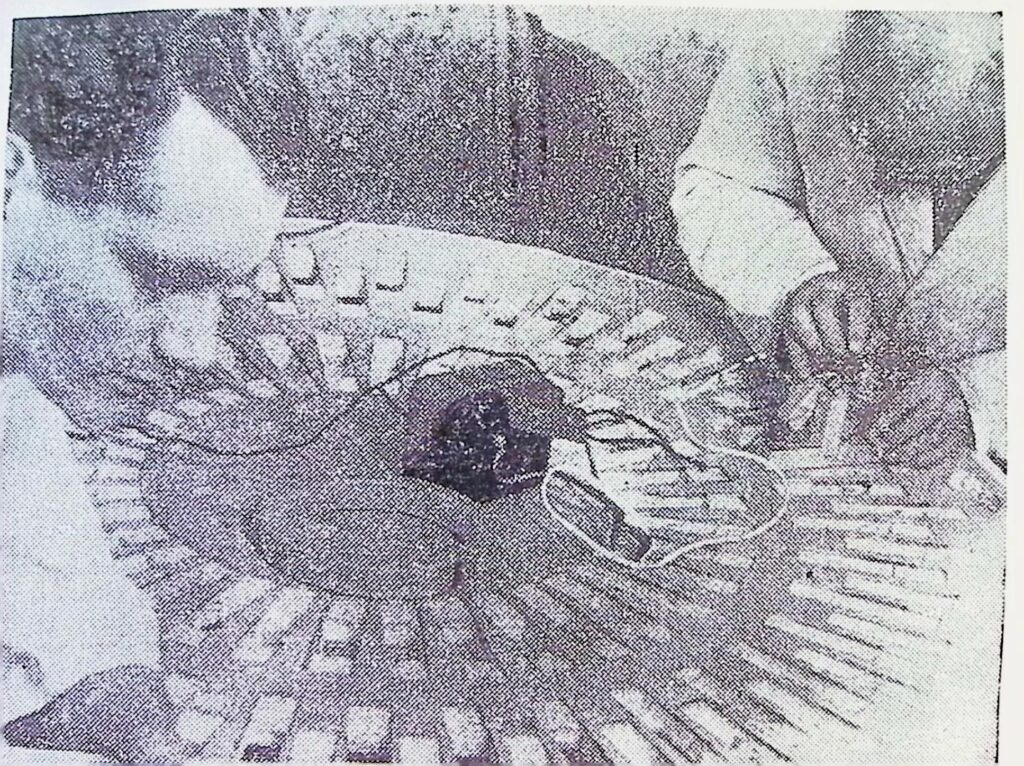
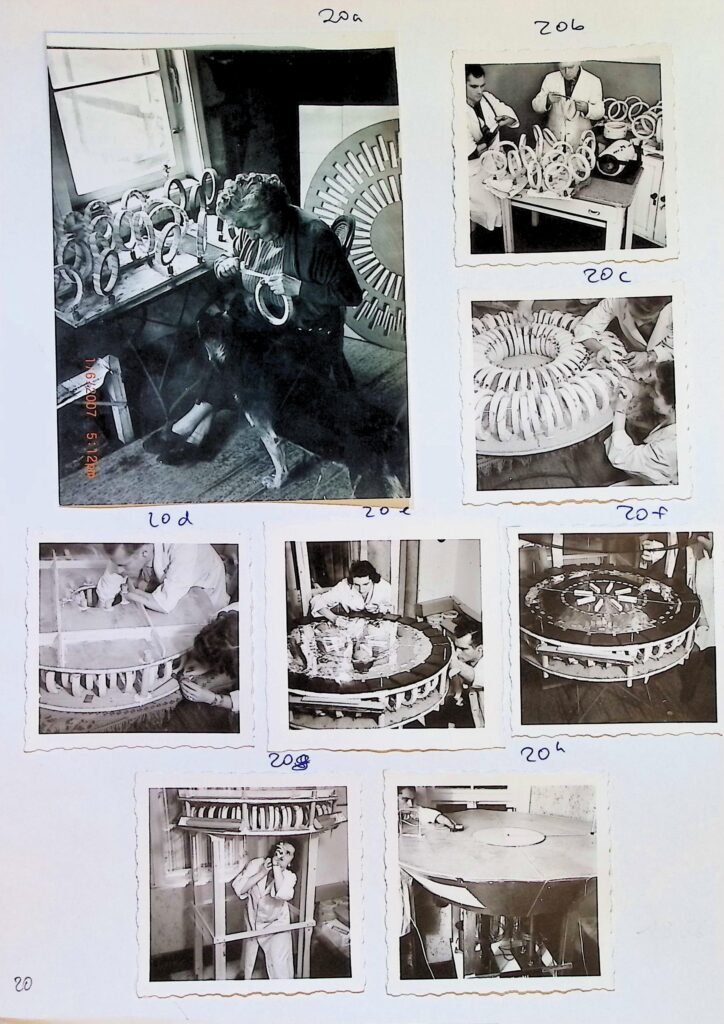
The central experimental arrangement consisted of a complex device, often referred to as the “Contrabator.”
Essential components:
- Ring-shaped structures (waveguide rings)
- e.g. inner radius: 9.15 cm
- outer radius: 7.65 cm
- number: up to 60 rings
- Microwave excitation (~3 cm wavelength)
- calculated as an optimal compromise between size and precision
- calculated as an optimal compromise between size and precision
- High-frequency systems (magnetron / klystron)
- required to generate sufficient field strength
- required to generate sufficient field strength
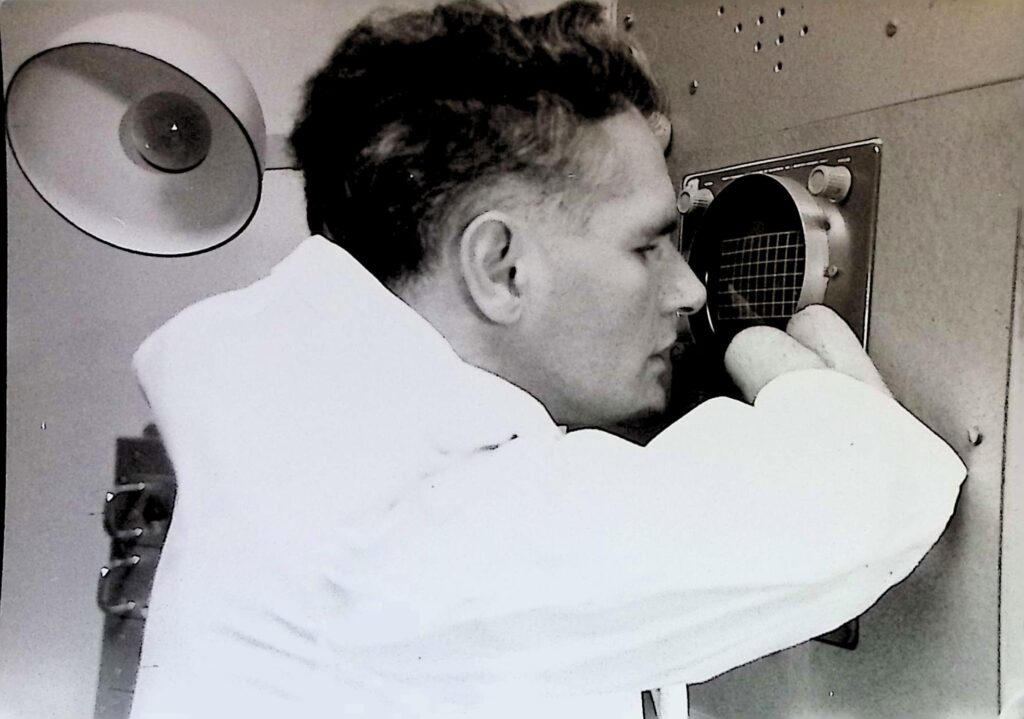
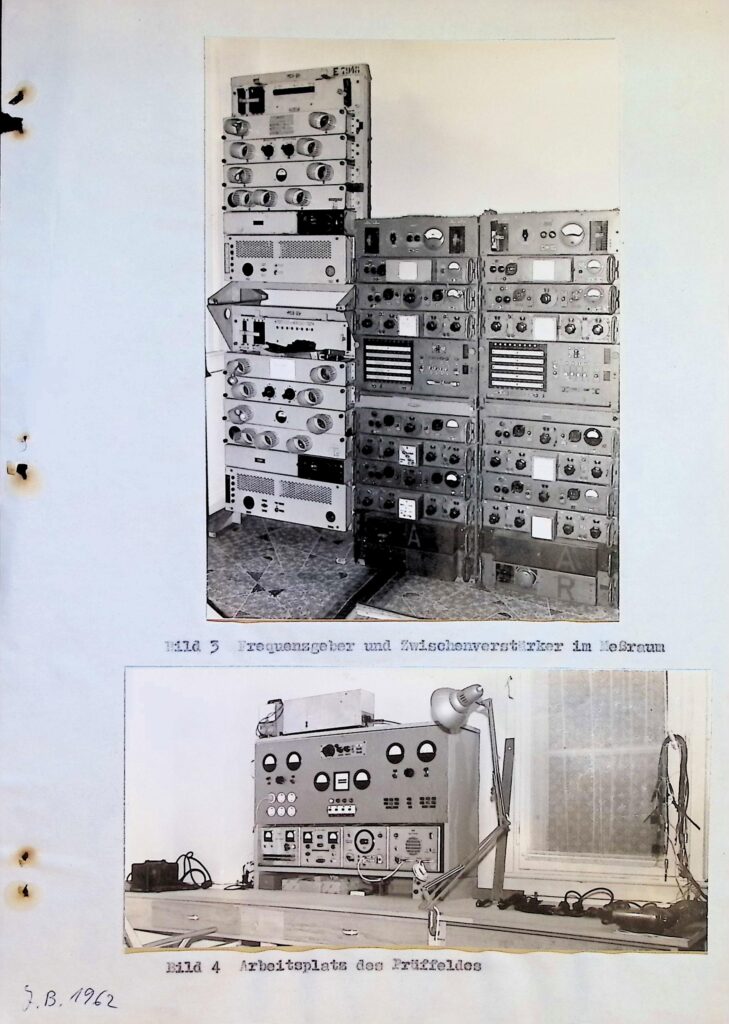
- Measurement system:
- suspended test body
- whose positional change is measured
- conversion into electrical signals (frequency modulation)
- visualization on an oscilloscope
Measurement Principle
The planned detection was indirect and technically demanding:
- A test body is softly suspended
- The contrabary effect is expected to produce a periodic change in weight
- This leads to a mechanical displacement
- This displacement is converted into an electrical oscillation
- This signal is amplified and displayed on an oscilloscope
The measured curves were then to be compared with theoretical integral curves.
Scope of the Experimental Series
The experimental work was more extensive than often assumed:
- already in 1956 approximately 800 individual experiments
- organized into:
- 4 experimental complexes
- each with 4–5 series
- each with 40–50 individual experiments
Technical Difficulties
The experiments did not fail at a single point, but due to a combination of fundamental difficulties:
1. Signal problems
- strong electromagnetic disturbances
- unclear measurement curves (superpositions instead of clear signals)
2. Insufficient power
- required power levels (e.g. ~1000 W) difficult to achieve
3. Precision requirements
- construction strongly dependent on wavelength
- either extremely large apparatus or extremely high manufacturing precision required
4. Measurement technology
- required sensitivities in the microvolt or sub-microvolt range
- technically difficult with the available means
Funding and Resources
Funding was limited and fragmented:
- 1959:
- Bölkow: 10,000 DM
- Wolfgang Essen: 5,500 DM
- Hackländer: 1,200 DM
- in some cases only a few thousand DM available in total
- example: only 2920 DM for device development
Consequences:
- improvised construction
- procurement of materials from:
- electrical scrap
- workshops
- borrowed tools and machinery
Role of the Family
The experimental work would not have been possible without Heim’s family:
- his father worked daily up to 6 hours in the laboratory
- his mother and later his wife actively supported the construction
The family was therefore effectively an integral part of the research program.
End of the Project
Several factors led to the termination:
1. Financial problems
- drastic reduction of funding (1964 only ~4000 DM)
2. Technical stagnation
- no unambiguous experimental confirmation
- increasing complexity
3. Personal turning point
The decisive break came with the death of his father:
- December 1964
- loss of his most important collaborator and supporter
Heim himself subsequently described a state of complete loss of working capacity over several years.
Classification
The contrabary program shows:
- Heim actively attempted to test his theory experimentally
- The experiments were highly ambitious and ahead of their time
- The implementation failed primarily due to:
- technology
- funding
- organizational structure
This phase marks the transition:
→ from an experimental approach
→ to the later dominant purely theoretical development of his field theory
Historical technical supplement
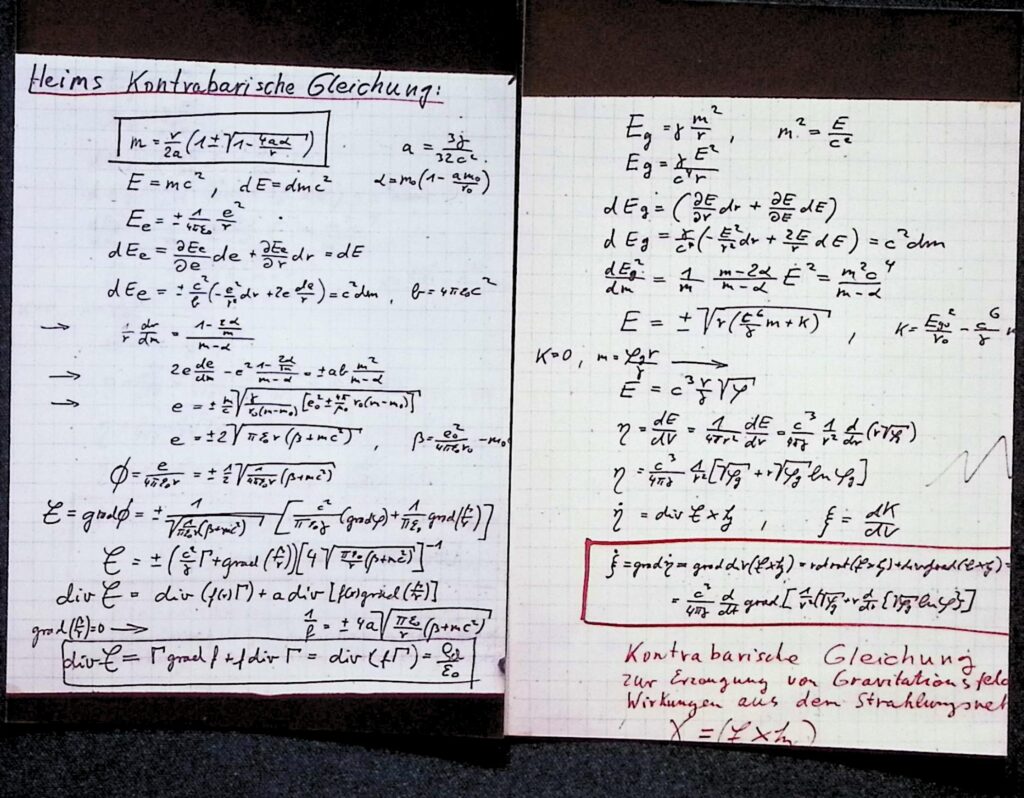
For the historical and technical classification of contrabary, we also provide a later paper by Illobrand von Ludwiger:
“The Unified Field Theory and the Principle of Contrabary – Additions, Clarifications, and Corrections to Burkhard Heim’s Early Papers.” This text does not simply repeat Heim’s early publications on contrabary, but reinterprets them in light of the later field theory, adding clarification, precision, and partial correction.
This paper is especially important for the present page because it shows that Heim understood the contrabaric effect as a consequence of his unified field theory, not as an isolated technical speculation. Ludwiger places the early texts in their historical setting, reconstructs the physical derivation in the context of Maxwell-like field equations, and also revisits the experimental line involving the contrabator, waveguide rings, and microwave excitation. At the same time, the paper makes clearer why the historical experiments were not able to demonstrate the hoped-for effect in a decisive way. It is so far only available in german.
Download:
Historische Zusammenfassung der Kontrabarie-Gleichungen von Illobrand von Ludwiger (nicht letzte Ergebnisse) – PDF herunterladen
Sources and State of Preservation
The present-day reconstruction of contrabary is based on Burkhard Heim’s early publications, letters, later recollections, historical summaries, and subsequent reconstructions and commentaries. However, according to the current state of the archive, neither a complete original theoretical treatment of contrabary by Heim nor a complete contemporary documentation of the experiments carried out at the time appears to survive in a closed and complete form.
This means that contrabary can presently be reconstructed only fragmentarily and indirectly. Many statements concerning the theory, the experimental setup, and the intended goal can be derived from the surviving sources, but the transmission remains incomplete. The material presented here should therefore be understood as a historical reconstruction based on the documents currently available.
Current Work and Outlook
The currently available works, derivations, and documents of Burkhard Heim are being systematically analyzed in order to establish a foundation for a modern reconstruction and possible continuation of the original experimental program. The aim is to evaluate, under present-day technological conditions, whether the effects pursued at the time can be investigated more precisely or newly realized.
At the same time, the new Heim working group is actively examining other historical and contemporary experimental programs that may point toward similar structural effects to those Heim aimed to demonstrate in his setup. These include in particular:
- Electrogravitics of Thomas Townsend Brown
Early high-voltage experiments using asymmetric electrodes and capacitor-like arrangements, in which Brown reported directed force effects and interpreted them as a possible indication of electrical interaction with gravity. (the “Biefeld–Brown effect”).
→ Background: https://en.wikipedia.org/wiki/Thomas_Townsend_Brown - “Exodus Effect” (Alt Propulsion Research)
A propellantless propulsion research program centered on asymmetric electrostatic pressure in high-field capacitor-like structures. The experiments investigate whether carefully engineered electrode–dielectric geometries can produce a measurable net force in high vacuum, with particular attention to charge retention, dielectric behavior, and the suppression of ion-wind or plasma artifacts.
→ https://www.altpropulsion.com/exodus/ - Searl Effect Generator (SEG)
A controversial concept based on rotating magnetic rings and roller assemblies, in which John Searl claimed not only energy anomalies but also levitation- or propulsion-like effects. The SEG has attracted attention in alternative propulsion discussions, but it is not independently established and remains the subject of speculative as well as critical debate.
→ https://www.altpropulsion.com/searl-effect/ - Mach-Effect Propulsion / “MEGA Drive” by James F. Woodward
A theoretically motivated propellantless propulsion approach based on Woodward’s proposed transient mass fluctuations associated with Mach’s principle. In practice, the work has typically focused on piezoelectric stack actuators, which are driven electrically in an effort to produce tiny periodic net thrust effects. The concept later became known publicly as the MEGA Drive; the reported signals remain small and in need of further independent confirmation. → https://www.altpropulsion.com/the-first-step-to-the-stars-james-f-woodwards-mega-drive-and-mach-effect-propulsion/ → https://www.altpropulsion.com/the-woodward-effect-machs-principle-and-carver-meads-g4v/
→ Background: https://en.wikipedia.org/wiki/Mach_effect this research direction is currently being further developed and investigated by Curtis Horn and others.
The goal of this comparative approach is to identify possible common structures, differences, and experimental indications that may allow for a new evaluation or interpretation within the framework of Heim theory.

