
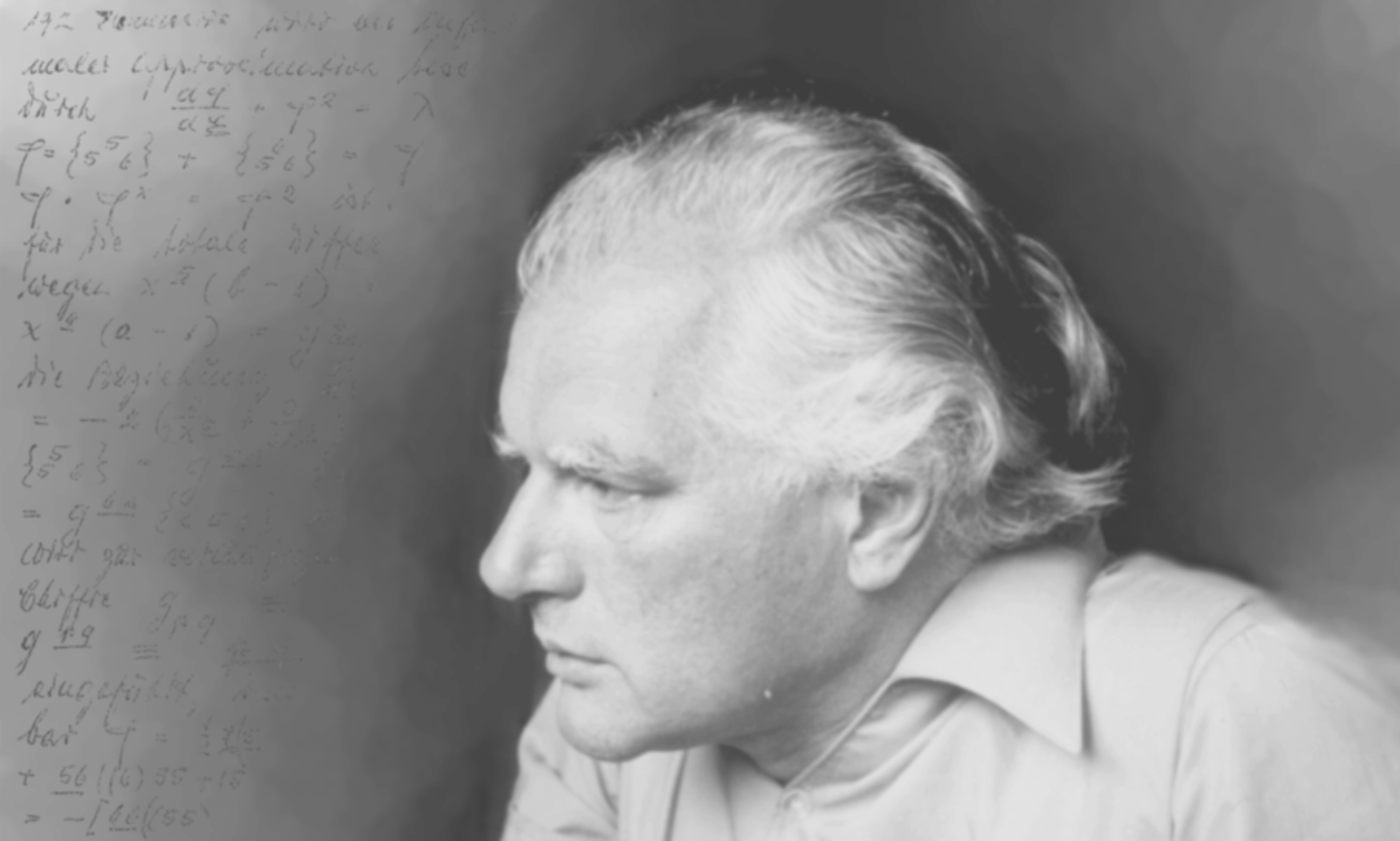
Heim’s mass formula is one of the best known and most discussed parts of Heim Theory. The reason is simple: this is where Heim’s general claim of a geometric structural theory of matter comes into direct contact with a concrete physical question, namely the masses and further properties of elementary particles. For many readers, the mass formula is therefore the first point at which Heim appears not only as the author of a broad theory, but as someone whose approach can be measured against known particle data. The accompanying texts of the former research group stress exactly this point. There the mass formula is presented as part of Heim’s six-dimensional structural theory, from which not only particle masses but also resonances, lifetimes, the fine-structure constant, and neutrino masses are supposed to follow.
The purpose of this page is to bring together the material on the mass formula in a way that is historically clearer and more useful than a simple list of documents. In doing so, it is important to distinguish three levels: the surviving texts by Burkhard Heim himself; the later introductions and derivations produced by the former AK Heim-Theorie, more specifically the Research Group Heim’s Theory / IGW Innsbruck; and the current reconstruction work, which is re-evaluating some of the historical and mathematical questions. A large part of the accompanying material now read together with the mass formula comes from the working phase of the former research group in the early 2000s, especially between 2002 and 2004. These texts are not original texts by Heim, but they are central for understanding both the transmission and the later reception of the material.
Why we speak here of Mass Formula A and Mass Formula B
On this website we deliberately use the neutral labels Mass Formula A and Mass Formula B. The reason is not convenience, but the historical state of the surviving material.
Mass Formula A is the version connected with the programming and evaluation carried out at DESY in 1982. The corresponding document was published by the former research group explicitly as a reproduction of Burkhard Heim’s original text for the programming of his mass formula, and the text itself carries the date 25 February 1982.
Mass Formula B is the later transmitted extended version. In the documents of the former research group it is linked to a report which, in that form, was sent to MBB/DASA in 1989. That is how the relevant working-group texts describe it.
But the matter is not quite so simple. The fact that a report version was sent in 1989 does not automatically mean that the mathematical content of that version itself must have originated only in 1989. In current reconstruction work there are good reasons to handle this question more carefully. There are indications that substantial parts of the later transmitted extended version are older and stand in a closer relation to the calculation already programmed in 1982 than the simple labels “1982” and “1989” would suggest. Precisely because this dating question is still part of an ongoing reconstruction and should not be closed by artificial certainty, we use the neutral labels A and B. In that way it remains visible that we are dealing with two different transmitted versions within one connected field of work, without claiming more certainty than the present sources actually allow.
The programming issue and the coefficient matrix
One point that has often been discussed later concerns the form in which Heim prepared his calculation for the DESY evaluation of 1982. Critics have repeatedly treated certain tabular or coefficient-like intermediate forms as signs that known particle masses were simply adjusted after the fact. The current reconstruction takes a different view.
The more plausible interpretation today is that Heim had to break the overall calculation into several intermediate steps in order to make it executable on the computing hardware available at the time. If that is correct, then such coefficients and intermediate matrices are not the origin of the formula, but a computational working form needed for programming and actually carrying out the calculation. This does not answer every open question, but it clearly shifts the way the sources are read: away from the simple accusation of fitting and toward the question how Heim made a complex calculation practically realizable under the technical conditions of his time.
Documents on this page
The following materials are the most important documents connected with the mass formula. They differ in origin, purpose, and character and should not all be read in the same way.
Mass Formula A
This document is one of the most important foundation texts for historical work on Heim’s mass formula. The former research group explicitly published it as a reproduction of Burkhard Heim’s original text for the programming of his mass formula. It contains the symbolism, quantum numbers, auxiliary functions, selection rules, and mass spectrum in the form in which Heim had prepared it for programmed calculation. Anyone who wants to understand how the DESY calculation of 1982 was actually set up must begin here.
[Download PDF]
Mass Formula B
This document preserves the extended version of the mass formula. In the former research group it was linked to a later report version sent to MBB/DASA, while at the same time it remains open today how far its mathematical core may already have existed before that report version. In content, this version is important because it was meant to go beyond the ground-state calculation and also include lifetimes, neutrino masses, and the fine-structure constant. For current reconstruction this is one of the most interesting and at the same time most difficult documents in the whole complex.
[Download PDF]
Short Introduction to Heim’s Mass Formula
This short introduction comes from the work of the former AK Heim-Theorie and tries to present the mass formula in a more generally understandable way within its wider structural context. The text states explicitly that it is not an original contribution, but an attempt to make Heim’s extensive main works more accessible. For many readers, this is the best first point of entry.
[Download PDF]
On the Derivation of Heim’s Mass Formula
This is the most detailed derivational text of the former research group. It was written by I. von Ludwiger and K. Grüner and treats the mass formula as part of a wider geometric context: gravitation in the micro-domain, six world coordinates, polymetric geometry, correlations of the partial structures, the fine-structure constant, basic states, resonances, and neutrino masses. Anyone who wants more than an overview and wishes to follow the internal structure of that earlier reconstruction will find here the most important text of the former group.
[Download PDF]
Selected Results
This document gathers tables and numerical results. It includes the quantum numbers of the basic states, theoretical particle data, experimental comparison values, and tables of meson and baryon resonances. It shows very clearly how the former research group wanted to present the subject: not only as a theoretical claim, but in a comparative and tabular form. One should keep in mind, however, that the tables reflect the state of the data at that time and must therefore be read historically.
[Download PDF]
Remarks on the Physicist Burkhard Heim
This text is not a mathematical introduction, but a short biographical and reception-historical frame. It explains why Heim, despite some remarkable results, was only slowly received by the broader scientific community and describes the difficult conditions under which his work was read. It is especially helpful for understanding why the later mediation work of the former research group became necessary at all.
[Download PDF]
On the State of Elementary Particle Physics
This text places Heim and the mass formula in the broader physical context of the standard model, quantum field theory, and quantum gravity. It shows from which problems and standards of comparison the former research group approached Heim when positioning him against established physics. Anyone who wants to understand the group’s perspective on Heim more clearly should read this text alongside the others.
[Download PDF]
Bibliography
The bibliography is not an introductory text in the narrow sense, but it documents very well the scholarly horizon of the former research group. It connects Heim with standard sources in particle physics, gravitation, quantum theory, and other approaches. In this way it shows that these works were not meant as purely internal notes, but as an attempt to make Heim readable within a larger physical context.
[Download PDF]
Note on language
Most of the documents on this page are currently available only in German. We are working in the background on English translations and on a clearer bilingual presentation. Until those translations are available, it can already be very useful to explore the German texts with the help of a good language model or another translation tool. Especially in the case of dense technical texts, this can make both the structure and the content much easier to follow.

