
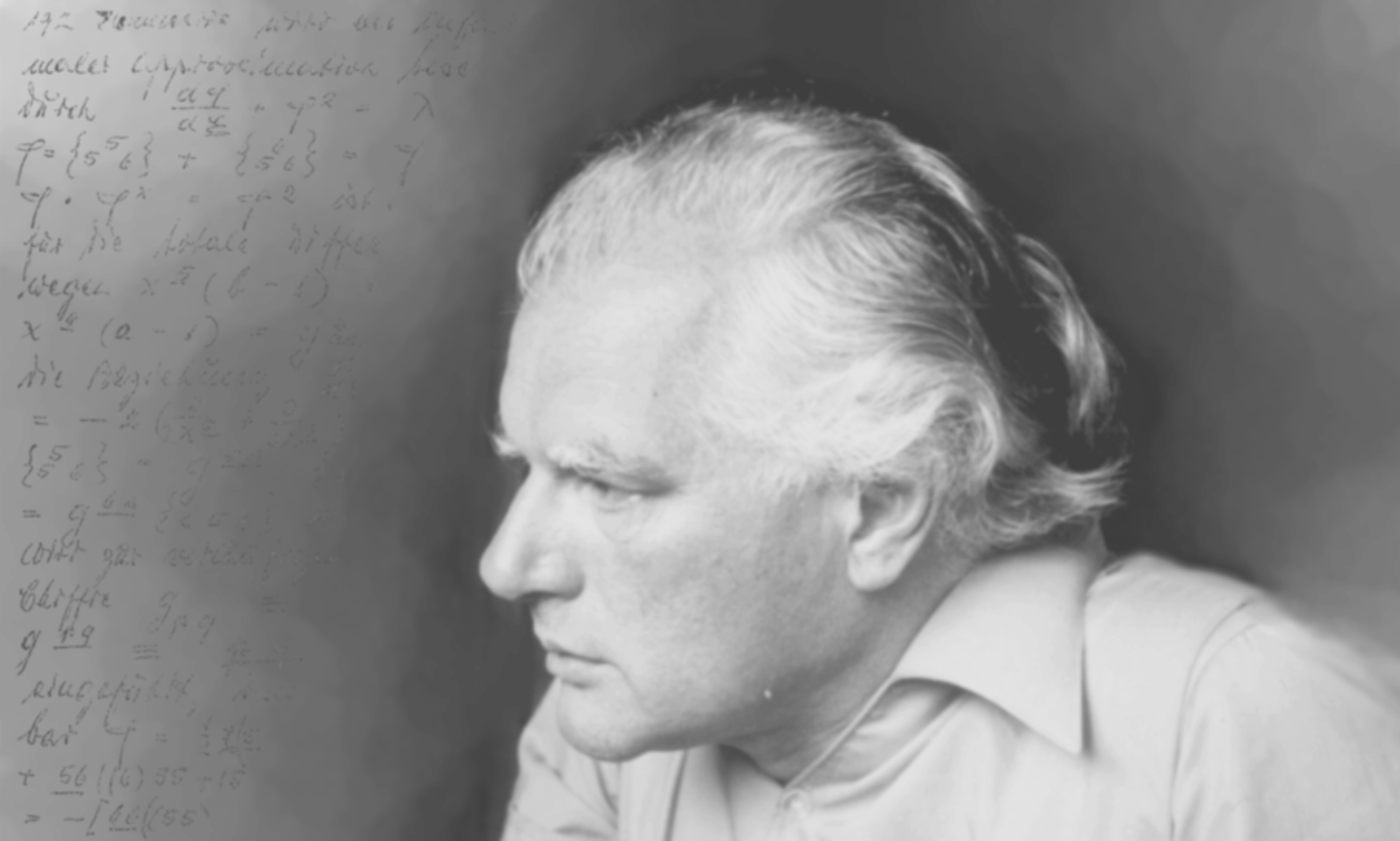
Lecture at Messerschmitt-Bölkow-Blohm (MBB), Ottobrunn – November 25, 1976
Basic Thoughts on a Unified Field Theory of Matter and Gravitation
Download:
[PDF – Basic Thoughts on a Unified Field Theory (MBB Lecture 1976)]
Introduction
The text provided here is a transcription of a lecture by Burkhard Heim, delivered on November 25, 1976 at the company Messerschmitt-Bölkow-Blohm (MBB) in Ottobrunn.
This lecture represents one of the few documented occasions in which Heim presented his theory in a coherent and continuous form to a technically and scientifically trained audience.
Context and Institutional Framework
Messerschmitt-Bölkow-Blohm (MBB) was one of the central German companies in the fields of aerospace and high technology during the 1960s and 1970s.
Burkhard Heim was not merely loosely connected to this environment, but was associated with MBB over an extended period in a consulting capacity and received regular compensation for this work. His research was discussed there in the broader context of fundamental physical questions concerning the structure of matter, gravitation, and energy.
The lecture of November 25, 1976 took place within the framework of an internal scientific colloquium at MBB.
Contemporary indications and later editorial analysis of photographic and accompanying materials show that high-ranking physicists were present among the audience, including in particular Pascual Jordan and Gebhard Lyra.
In addition, within the MBB environment, the possibility of an experimental program aimed at investigating gravitational or gravito-magnetic effects in connection with Heim’s theoretical framework was discussed for a certain period of time. Documents from the Ludwiger estate indicate that concrete experimental concepts — for example involving highly sensitive SQUID measurement techniques — were at least partially developed.
These efforts encountered significant practical and especially financial obstacles. Contemporary assessments emphasize that any realization would have required substantial technical infrastructure and institutional support, which ultimately prevented implementation.
Later work within MBB also shows that the question of experimental influence on gravitational fields continued to be investigated at a theoretical level, but always under the premise that a consistent unified field theory would first be required.
MBB itself was later integrated into the European aerospace industry and, through a series of mergers, became part of what is now the Airbus Group.
Nature of the Document
The present text is not an original publication from 1976, but is based on audio recordings of the lecture.
The current version was produced through:
- transcription of the audio recordings
- linguistic refinement
- editorial processing
- addition of figures and an index
with contributions from, among others, Wilfried Kugel and Olaf Posdzech.
The text therefore reflects the content of the lecture as accurately as possible, while retaining the character of a reconstructed spoken presentation.
Structure of the Content
The lecture follows a clearly defined objective: to formulate the fundamental conditions for a unified physical theory.
1. Starting Point: Limits of Existing Theories
Heim analyzes the situation of physics from a structural perspective:
- General relativity describes the geometry of spacetime, but does not provide a theory of elementary matter units.
- Quantum theory describes microscopic processes, but lacks a consistent geometric foundation.
This results in a fundamental gap.
2. Requirement for a Unified Theory
A complete physical theory must satisfy two conditions simultaneously:
- it must be quantized
- it must be formulated geometrically
From this it follows that such a theory can only be formulated as a theory of elementary quanta of matter.
3. Introduction of the Matter Field Quantum
Heim introduces the concept of a universal matter field quantum.
This entity serves as the common basis for:
- massive particles
- massless field quanta
All known particles thus appear as structurally different states of a higher-order system.
4. Structural-Theoretical Approach
Physical reality is not understood as a continuous field, but as a system of discrete, geometrically defined units.
This shifts the focus:
- from continuous fields to discrete structures
- from purely differential descriptions to structural ordering principles
5. Aim of the Theory
The goal is to derive observable physical quantities — in particular particle masses — from the structure of these elementary units.
The theory therefore aims at a fully structure-based description of the material world.
Relation to the Main Works
The MBB lecture precedes the full mathematical development of the theory in both time and content.
It fulfills a specific function:
- coherent presentation of the overall approach
- reduction of formal complexity
- direct insight into Heim’s mode of reasoning
The complete mathematical formulation is found only in later works, particularly in Elementary Structures of Matter.
Significance of the Lecture
The lecture is one of the most important sources for understanding Heim’s theory because it:
- formulates the core idea in a compact form
- clearly outlines the methodological objective
- makes the transition from physical intuition to formal theory visible
It therefore provides a direct point of access to the conceptual foundation of the theory.
Download
[PDF – Basic Thoughts on a Unified Field Theory of Matter and Gravitation (MBB, 1976)]

