
What does “Syntrometrische Maximentelezentrik” mean?
The title of Burkhard Heim’s late major work is itself a compressed program. It is not merely a heading, but part of the conceptual architecture of the work. As in many other places, Heim does not choose a casual name here, but constructs an expression in which a formal and philosophical intention is already condensed. This applies especially to the two parts Syntrometry and Maximentelezentrik, each of which can be read through Greek-philosophical layers of meaning. At the same time, an important caution is needed: this decomposition is an editorial interpretation of the word architecture, not simply a literal translation explicitly given by Heim himself. Heim defines the function of Syntrometry directly, whereas the finer internal analysis of the full title has to be reconstructed from his terminology and from the inner structure of the work.
The first part, Syntrometry, can plausibly be read from three sense-components: syn- in the sense of “together,” “with,” or “in relation”; trop- / tropos in the sense of turn, mode, or structural orientation; and metron / metria in the sense of measure, order, and formal determination. Heim himself defines syntrometry functionally as the search for an analytical schema by means of which formal operation becomes possible in arbitrary logical systems. In this sense, syntrometry may be understood as a formal doctrine of measure and order for interconnected modes of structure. It is directed not only toward single statements, but toward the comparability and formability of whole orders of aspect and statement.
The second part, Maximentelezentrik, is more difficult, but for that reason all the more revealing. Within the work itself, Heim develops an entire family of tele-central terms: tele-centre, tele-centrality, secondary tele-centres, pseudo-tele-centrality, tele-central domain, and the televariant aeonic area. This shows that the title is not poetic ornament, but points to a real inner architecture of the work.
For the interpretation of the middle element entele- / tele-, the Aristotelian background is decisive. In that context, telos does not mean merely an external goal, but the end, completion, and fulfillment of a thing according to its own nature. Entelecheia accordingly means realized fullness: the having-come-to-itself of what was already present in a thing as an inner possibility. In this sense, entele- / tele- points not merely to purposiveness, but to immanent completion: to a structure that bears its own fulfillment within itself and comes to that fulfillment.
This fits the fact that Heim elsewhere also works explicitly with the Aristotelian family of terms, for example in the entelechial dimension. In the glossary tradition, this is defined as a hidden world-dimension normal to physical spacetime; in later Heim-related expositions, it appears together with the aeonic dimension as a background-domain of organization, steering, and inner world-order. The entelechy family is therefore not accidental in Heim, but belongs to his expanded view of the world.
If one reads the full title together, the following cautious editorial interpretation emerges:
- Syntrometry: a formal doctrine of measure and order for interconnected modes of structure
- Maximentelezentrik: the highest or maximal centering toward immanent completion
Taken as a whole, the title may therefore suggest something like a formal doctrine of maximal centering toward inner fulfillment — that is, an order of structures that are not merely externally linked, but gathered and articulated toward their own highest completion.
On Burkhard Heim’s Syntrometrische Maximentelezentrik
Burkhard Heim’s Syntrometrische Maximentelezentrik is one of the most unusual and demanding works in his overall corpus. It is not simply an appendix to his physics, but an attempt to place the question of valid knowledge itself at the center of the investigation. Heim begins from the view that ordinary human logic and ordinary forms of perception represent only a particular, anthropomorphic access to reality. He therefore asks whether a more universal method can be reached through a reflexive abstraction from this anthropomorphic transcendental aesthetics. He calls this method syntrometry.
The work develops this project not as a loose philosophical essay, but through a distinctive combination of epistemology, conceptual analysis, and formal construction. Heim begins with subjective aspects: the way statements, valuations, and qualitative determinations are organized within a given standpoint of consciousness or cognition. From there he proceeds through aspect systems, categories, apodictic elements, functors, and quantors to the central syntrometric structure itself: the Syntrix. This is followed by further layers such as Syntrix corporations, enyphan syntrices, metroplex theory, televariant structures, and, in the second part, anthropomorphic syntrometry, metronic operations, and selector theory. The architecture of the work already shows that Heim is attempting a general structural doctrine of cognition, order, genesis, and relation, rather than offering a minor terminological supplement to his physical theory.
For that very reason, the Syntrometrische Maximentelezentrik is often difficult for contemporary readers. Heim uses a language of his own, introduces many terms in a highly compressed form, and combines philosophical foundational questions with intended formal structures without always recasting them in modern mathematical notation. The work is of major historical and systematic importance, but it demands careful reconstruction.
The English works by Marko Miloradovic presented here should be understood against this background. They are not simple literal translations of Heim’s original text. Unifying Dimensions: Exploring Burkhard Heim’s Syntrometric Vision follows the architecture of Heim’s work quite closely and seeks to unfold its main ideas chapter by chapter in English, explaining them and placing them in a broader systematic context. It is best read as an expanded analytical study of Heim’s syntrometry.
The second work, A Modernized Syntrometric Logic: Foundations and Applications, goes a step further. It explicitly presents itself as a reinterpretation, modernization, and extension of Heim’s project. To do so, it recasts syntrometric concepts in the language of contemporary logic: with a formal language, Kripke semantics, modal and dynamic operators, and a sequent calculus. Its aim is therefore not only to explain what Heim wrote, but also to ask how the underlying ideas of syntrometry might be reconstructed more rigorously and developed further with present-day logical tools.
The relation between these English texts and Heim’s original work is therefore clear. They do not replace the original, but stand on a second level of work above it. One is primarily explanatory and interpretive; the other is explicitly modernizing and developmental. Anyone who wants to understand Heim’s own movement of thought, his conceptual language, and the historical form of the project must return to the original text. Anyone seeking a more systematic English approach, or an indication of how syntrometric ideas may be reformulated in contemporary language, will find Marko Miloradovic’s studies to be both a useful guide and an independent continuation of the discussion.
We are happy that there is finally an english translation and further works on Heims aspect relative n-valued logic system called Syntrometry. You can find the articles about this originally here -> https://figshare.com/authors/Marko_Miloradovic/21382025
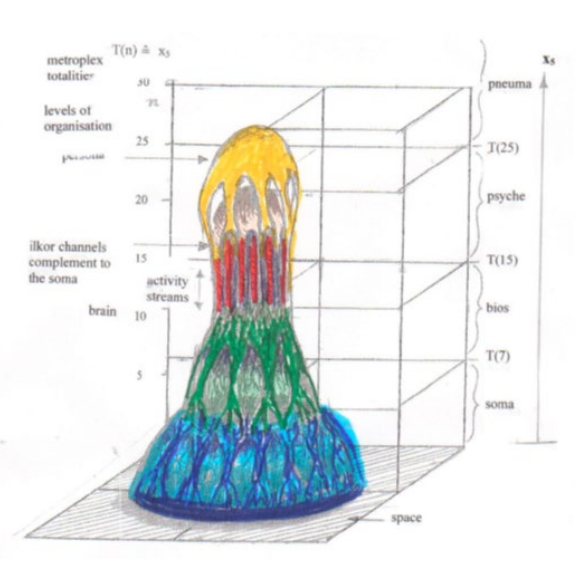
his diagram illustrates Heim’s concept of hierarchically structured organization in x₅, the dimension associated with form, information, and ordering principles.
The vertical axis represents increasing levels of organization, from purely physical structures (soma) to higher-order structures (bios, psyche, pneuma).
The branching structures visualize activity streams, which connect different levels and enable the transfer of structural information across domains.
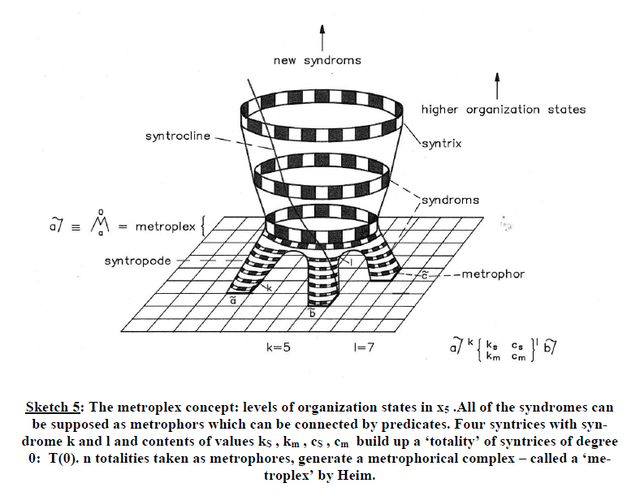
Heim introduces the concept of the metroplex as a higher-order structure composed of interconnected syntromes.
Syntromes can be understood as structured combinations of elementary states, which, when connected through logical relations (predicates), form larger coherent units.
A metroplex therefore represents a structured totality, in which multiple syntromes are organized into a unified system.
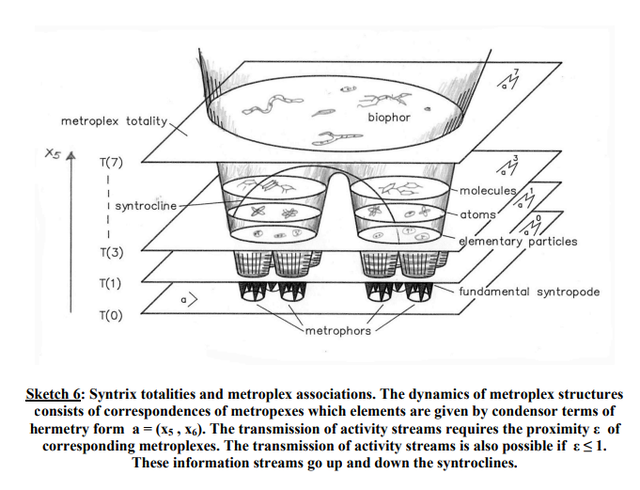
This diagram shows how metroplex structures relate to different layers of physical reality, from elementary particles to biological systems.
Each layer is associated with specific metrophors, while the connections between them are governed by syntroclines, which allow the transfer of activity streams between levels.
This represents Heim’s idea that physical, biological, and higher-order structures are not separate domains, but are interconnected through a common structural framework.
Remarks on the publication of „Syntrometric Telecentric of Maximes“ (Historical Text of Illobrand von Ludwiger)
The most important work by Burkhard Heim, his „Syntrometric Telecentric of Maximes“, has not been published until now. Parts of this manuscript I already saw in one of his labotatory rooms in Northeim (near Goettingen) when I was doing research on the photophoresis phenomenon during my semester vacations in 1958. When I asked Heim about the meaning of that title he explained to me that the manuscript is about a unified world view which not only includes quantitative physical revelations but also qualitative organic valuations of events in a so called „syntrometry“. The dynamic of physical and psychical events and live-processes are always adjusted to organizational targets, so called „telecenters“. Like motions of objects in space along geodesics they follow along extremales of expedient ideas in an entelechialy steered world – so-called „maximes“.
Only in 1976 did I see Heim’s work again. However the papers were bound into two thick hardcover books in A4 format, filled with hundreds of typed pages of text and with new formula-signs written in ink, which Mrs. Heim had inserted. On the occasion of a seminar in our company MBB (now AIRBUS) in Ottobrunn near Munich, which I arranged for our management, Heim presented these two books to the professors Pascual Jordan (University of Hamburg), Gerhard Lyra (University of Goettingen) and Heinrich Hora (University of Munich).
The physicists however were more interested in Heim’s phenomenological unified field theory and in his derivation of a unified mass-formula since from this concrete experiments can be derived.
Therefore, Heim first published his books „Elementarstrukturen der Materie“ (Elementary Structures of Matter), Vol. I: 1980/1989, Vol. II: 1983 and in 1996 in cooperation with Walter Droescher: „Strukturen der physikalischen Welt und ihrer nichtmateriellen Seite“ (Structures of the physical world and their non-material aspect). In 1980 Heim commanded a view of the „syntrometry“ in his book on „Postmortale Zustände?“ (Postmortem States?). (Subsequently SIEMENS director Dr. Selig asked me why Heim had to write a book just with „such a horrible title“? The sub-title “Die televariante Area integraler Weltstrukturen“ (The televariante area of integral world structures) could not help to save scientificity. Since in those days a physicist was not allowed to write about consciousness- and postmortem-states without having to fear serious consequences for his reputation as a scientist.
With the “syntrometry“, which is a generalized aspect-related logic, Heim tries to solve the ancient philosophical Body-Mind-Problem.
On the occasion of his death in 2001 neither a publication of the two volumes „Syntrometrische Maximentelezentrik“ took place nor did the theory of psychical processes receive any attention. It remains to be left for other generations of logicians and physicists to explore the deepness and range of Heim’s ideas.
The text about his formal logic is at least just as difficult to read as the one by Gottlob Frege („Grundgesetze der Arithmetik“, 1883-1903). Several physicists have already read the manuscripts about the syntrometry. The basic ideas on the syntrometry, partly in Heim’s own words, can be found explained in my book „Das neue Weltbild des Physikers Burkhard Heim,“ (2006/2013, Grünwald: Komplett-Media) and in the English version of that book in chapters 10.3 to 10.5. For better understanding, several basic definitions of the hirarchical term structure of this logical system are illustrated by help of sketches drawn according to Heim’s instructions.
Before the present publication a logician and PhD student of mathematics in Cambridge had planned to provide Heim’s text with footnotes which should contain respective references to similar modern works by logicians (for instance the Theory of Categories, the Entity-Relationship-Model from the basic theory of databank systems etc.). However, after our group had waited for some years, the logician gave up his cooperation for lack of time.
We soon gave up the idea to publish a shorter, limited version first. Nevertheless, we expected to attract the kind of international attention which Heim deserves by providing an English version. A member oft the Heim-research-group, who has been living in New York for some years, tried to translate the text in the past. However, it soon became obvious that he did not understand the meaning of many passages, so he had to stop the translation. According to the editor of Heim’s books, Prof. DDr. Andreas Resch in Innsbruck, Austria, a Spanish man, who tried to translate Heim‘s texts into his mother tongue, made the same experience. We hope that in the near future a publisher will be found who can enable a professional translation of this text into English.
We have now decided to publish the „Syntrometric Telecentric of Maximes“ by Burkhard Heim unabridged in the original German version on the internet.
Mr. Stefan Klemenz from Augsburg converted the typewritten version free of charge into a readable and publishable version and at the same time generated new formula signs, which so far did not exist as recognizable formular symbols for mathematics programs on computers. He’s presently working on a third volume.
Illobrand von Ludwiger, June 20, 2017

