
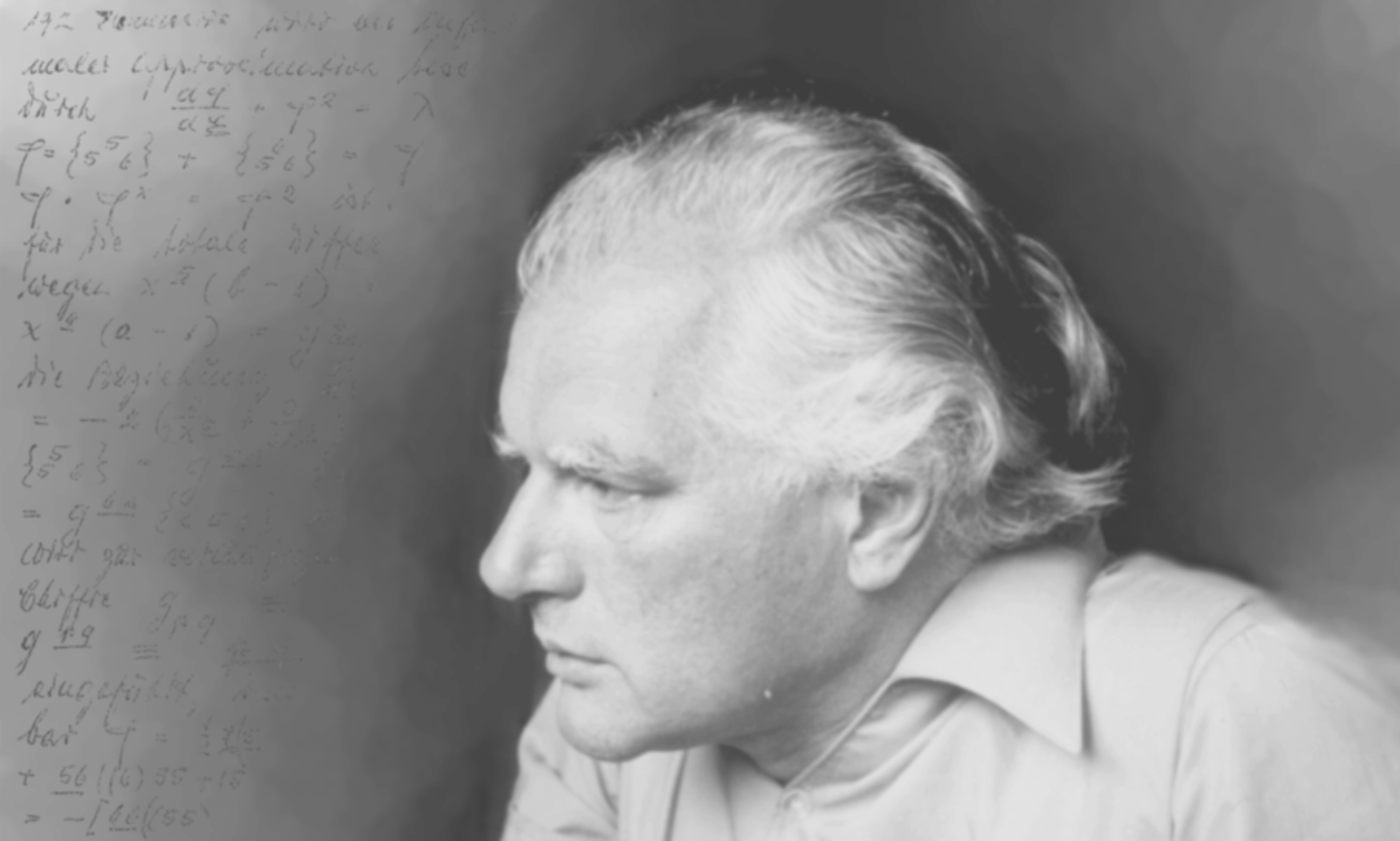
Heim Theory is not a single idea, nor merely an isolated physical hypothesis. It is a broader theoretical framework that brings together geometrical, physical, epistemological, and formal questions. Burkhard Heim did not seek to describe nature only in separate fragments, but aimed at a unified order in which space, matter, gravitation, elementary particles, lawfulness, and the conditions of scientific knowledge could be thought together.
For that reason, Heim’s theoretical work extends from the geometrical structure of the physical world to the description of elementary particles and onward to foundational questions of method and logic. Alongside his well-known work on the multidimensional structure of the world and on the mass formula, there also stands the question of how scientific description is possible at all, and where the reach of ordinary mathematical and logical procedures comes to an end. It is within this broader horizon that syntrometry also finds its place.
The following pages introduce the central theoretical fields of Heim Theory. They are not meant to exhaust the full scope of Heim’s work, but to offer an ordered path into its main themes.
Mathematics and Logic
This page presents Heim’s scientific program at a foundational level. Its focus lies on the role of mathematics as the precise language of the quantifiable external world, on the scope and limits of ordinary two-valued logic, and on Heim’s insistence that the conditions of knowledge themselves must become part of methodical reflection.
Syntrometry
Syntrometry is one of the most demanding and unusual parts of Heim’s work. It is concerned not only with physics in the narrower sense, but with a more general structural doctrine of cognition, aspect-dependence, order, and relation. This page introduces Heim’s original work and also explains more recent English studies and developments.
Mass Formula
The mass formula is one of the best-known and most frequently discussed parts of Heim Theory. It belongs to Heim’s attempt not merely to catalogue elementary particles empirically, but to determine their masses from a deeper geometrical and structural order. This page brings together the principal documents and offers an initial overview of their theoretical setting.
Glossary
Heim’s work employs its own conceptual language, and many of its terms are demanding even for readers already familiar with physics or philosophy. The glossary is intended to help place central terms such as metron, selector, syntrometry, televariance, polymetry, or mass formula in a concise and clear way. It is meant as a conceptual guide through the website.

