
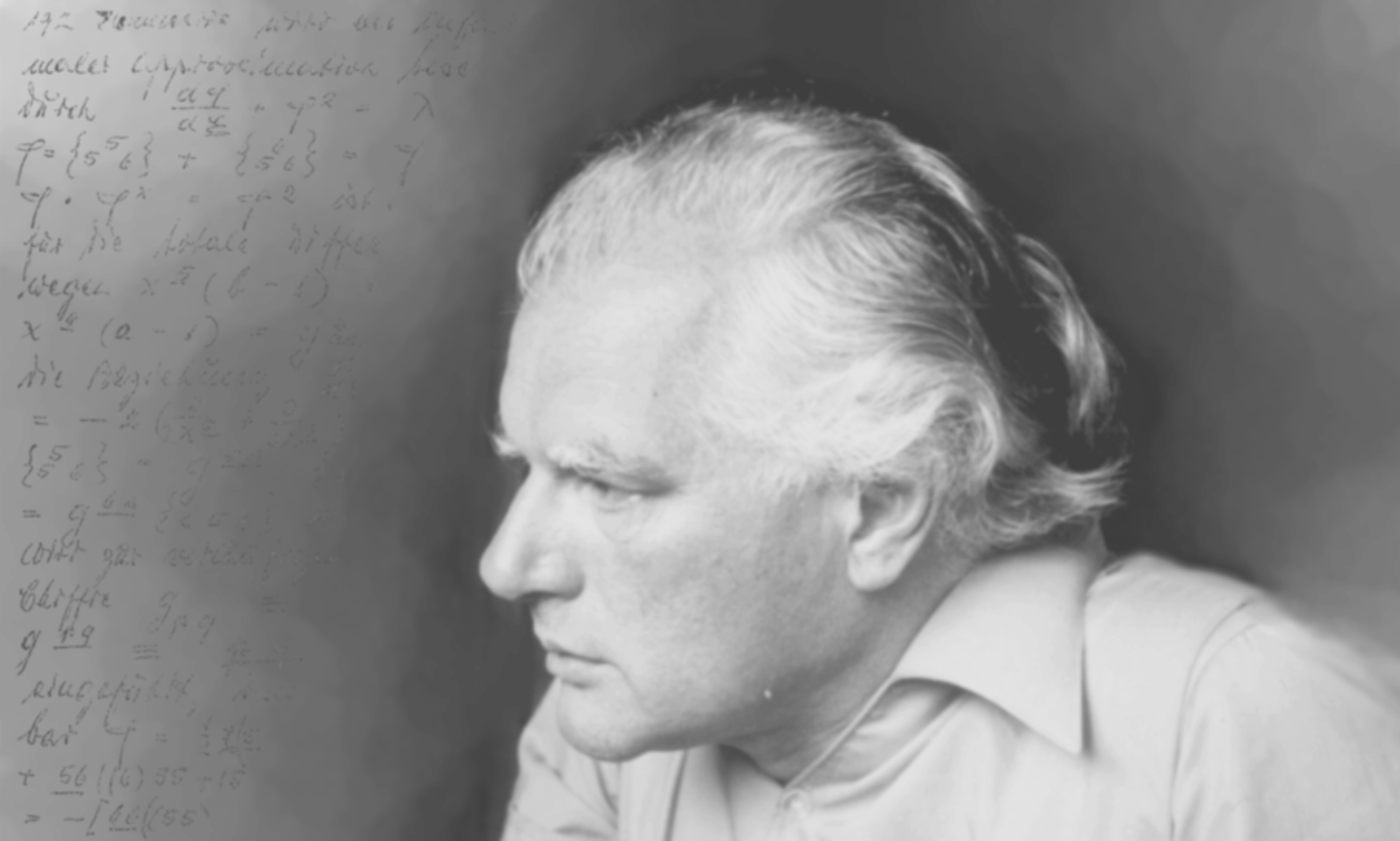
From the physical foundations of life and biological organization to new research on the origin of life.
A living organism consists of molecules. Yet no individual molecule is itself a living organism. Only through the organized interaction of many components do metabolism, regulation, reproduction, and the ability to respond to environmental changes emerge.
What, then, distinguishes living matter from nonliving matter? And how could such organization have arisen for the first time?
These questions occupy an important position in the work of Burkhard Heim. His theoretical program was not confined to gravitation, elementary particles, and spacetime. It extended to the organizational principles of living systems, biological evolution, the relationship between information and material structure, and the possibility of understanding physical, biological, and psychological reality within a common framework.
A new connection between Heim’s theoretical ideas and experimental biophysics is explored in a paper published in 2026 by Elmar C. Fuchs and Astrid H. Paulitsch-Fuchs. The authors investigate whether liquid water might serve not only as a chemical solvent but also as a physical intermediary between molecular dynamics and biological organization.
Read the original paper in BioSystems
What Is Life? The Question Behind Biology
Modern biology explains a remarkable range of processes through molecular biology, biochemistry, genetics, thermodynamics, and evolutionary theory. We understand many of the mechanisms through which cells convert energy, synthesize proteins, store information, and respond to their environment.
Nevertheless, the emergence of the first living systems remains an active field of scientific research. The formation of organic building blocks is not equivalent to the formation of a living organism.
A living system must integrate different processes. It requires chemical reactions that sustain its existence, some degree of separation from its environment, mechanisms of self-regulation, and eventually ways of preserving and transmitting functional information.
The fundamental question is therefore not merely how the components of life arose, but how these components became a continuously interacting and self-maintaining whole.
This distinction is central to Heim’s investigation. In The Elementary Process of Life (Der Elementarprozess des Lebens), he examines the material requirements of life, biological organization, heredity, and evolution. He asks whether describing individual physical and chemical processes is sufficient to capture the organizational principles of living systems.
Heim’s Understanding of Biological Organization
For Heim, an organism is not simply a collection of molecules. He describes living systems as hierarchically organized networks of interactions whose components stand in functional relationships with one another.
Molecules form larger structures, molecular systems operate within cells, cells form tissues and organs, and the activities of these different levels become integrated within the organism as a whole.
What matters is therefore not only material composition but also the organization of interactions.
A simple example illustrates this distinction. The chemical constituents of a living cell may also exist outside the cell. Yet only through membranes, metabolic pathways, catalytic networks, and regulated interactions do they form the integrated system we recognize as a living cell.
Heim employs concepts such as Soma, Entelechy, Merisms, and Holomorphism to discuss these relationships. In this context, holomorphism refers to an integrating organizational structure and should not be identified directly with the mathematical concept of a holomorphic mapping.
The theoretical challenge is to understand the relationship between individual material processes and the organization of the whole, without ignoring physical mechanisms or prematurely identifying biological organization with them.
Physis, Bios, Psyche, and Pneuma
In his broader conception of reality, Heim distinguishes several domains of description and lawful organization:
- Physis: material and energetic processes investigated primarily through quantitative physical methods.
- Bios: the specific organization and dynamics of living systems.
- Psyche: experience, perception, and psychological processes.
- Pneuma: mental and intellectual or spiritual processes in Heim’s terminology.
These distinctions are not intended to establish four isolated worlds. Rather, Heim investigates different yet interconnected aspects of reality and the possibility of developing a more general method for understanding their relationships.
This inquiry eventually leads to his theory of Syntrometry.
Why Water Was Already Important to Heim
The importance of water for biological processes was not an idea added to Heim’s work retrospectively.
In The Elementary Process of Life, included in the collected volume Mensch und Welt, Heim explicitly examines the requirements of a suitable reaction medium for carbon-based life on pages 108–109.
He identifies several important characteristics. The medium must permit molecular mobility, dissolve many substances, and support intermolecular interactions through its electrical properties. A high heat capacity, thermal stabilization, and the unusual density relationship between liquid water and ice are also significant.
From these considerations, Heim argues for the particular suitability of H₂O as the reaction medium of carbon-based biochemistry.
His discussion initially concerns the material conditions of life as we know it. It does not, by itself, constitute a complete theory of biological organization or rule out the scientific investigation of alternative forms of life chemistry.
Heim also discusses water in his Berlin lectures. During an exchange concerning the organization of matter, he addresses the dipolar properties of water molecules, changing molecular associations, and the possibility that their organization could be relevant to biological systems.
This provides a noteworthy historical connection with contemporary water research: Water appears not merely as the environment in which chemical reactions take place, but as a dynamically structured molecular system whose own behavior may influence biological processes.
From Information to Physical Reality
In Structures of the Physical World and Its Nonmaterial Aspect (Strukturen der physikalischen Welt und ihrer nichtmateriellen Seite), Heim extends his physical description through a hierarchy of coordinate and structural domains.
In addition to ordinary space and time, he distinguishes an organizational domain S₂, an informational domain I₂, and a more abstract domain G₄, to which he does not assign a direct physical interpretation.
He describes a sequence of projections through which structures associated with these domains could ultimately become expressed in the temporal development of physical events.
Schematically, this sequence can be written as:
G₄ → I₂ → S₂ → T₁ → R₄
Here, R₄ denotes ordinary spacetime, T₁ its temporal structure, S₂ the organizational domain, I₂ the informational domain, and G₄ the deeper abstract domain. Heim’s fuller discussion also involves an intermediate functional space between G₄ and I₂.
These additional coordinates should not be understood simply as extra spatial directions comparable to left, right, up, or down.
Heim describes the projection of organizational structures through time into physical actualization using the concept of rheomorphism.
Within his theoretical interpretation, such projections appear in the physical domain as probability amplitudes. This allows the question of biological organization to be formulated in a new way: Could the probabilities of possible molecular processes be influenced by additional structural relationships?
This possibility belongs to Heim’s theoretical program. It does not yet establish an experimentally verified mechanism connecting G₄ to biological systems.
New Research: Water as a Mediator of Biological Order
The 2026 publication by Elmar C. Fuchs and Astrid H. Paulitsch-Fuchs develops precisely this line of inquiry.
Original publication:
Water as a transducer layer between hyperspatial information and biological order: A hypothesis on the origin of life
Elmar C. Fuchs and Astrid H. Paulitsch-Fuchs, BioSystems, Volume 269 (2026), Article 105951.
Read the paper – DOI: 10.1016/j.biosystems.2026.105951
The central hypothesis is that water, owing to its distinctive molecular dynamics, could act as a physical transducer capable of translating very small changes in the probabilities of possible states into larger, transient patterns of organization.
Liquid water is not a rigid molecular network. Hydrogen bonds continually form, break, and reorganize. Consequently, the system can move among numerous molecular configurations with similar energies.
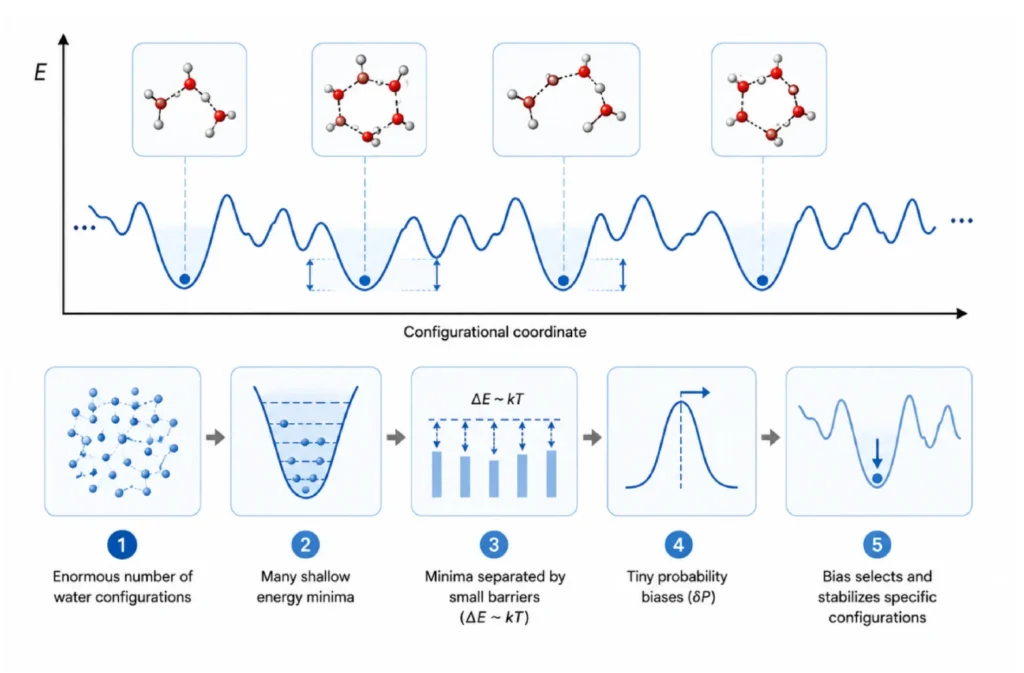
Under appropriate conditions, weak influences might alter the statistical distribution of these states. The authors investigate whether collective molecular dynamics could amplify such small changes and thereby affect the chemical environment of dissolved substances.
The Proposed Pathway from Information to Life
The paper outlines a five-stage mechanism:
- Information and projection: Building on Heim’s theory, the model assumes that rheomorphic processes may introduce small probability biases among physically admissible states.
- Water as a responsive medium: The large number of accessible molecular configurations makes water a possible medium for amplifying weak statistical changes.
- Collective organization: Coupled molecular and electromagnetic dynamics could favor transient forms of mesoscopic organization in water.
- Chemical selection: These structures could modify local reaction conditions, favoring particular pathways of molecular association and assembly.
- Stabilization of biological order: Through repeated processes, increasingly stable and functionally integrated molecular systems could develop, potentially leading toward early forms of living organization.
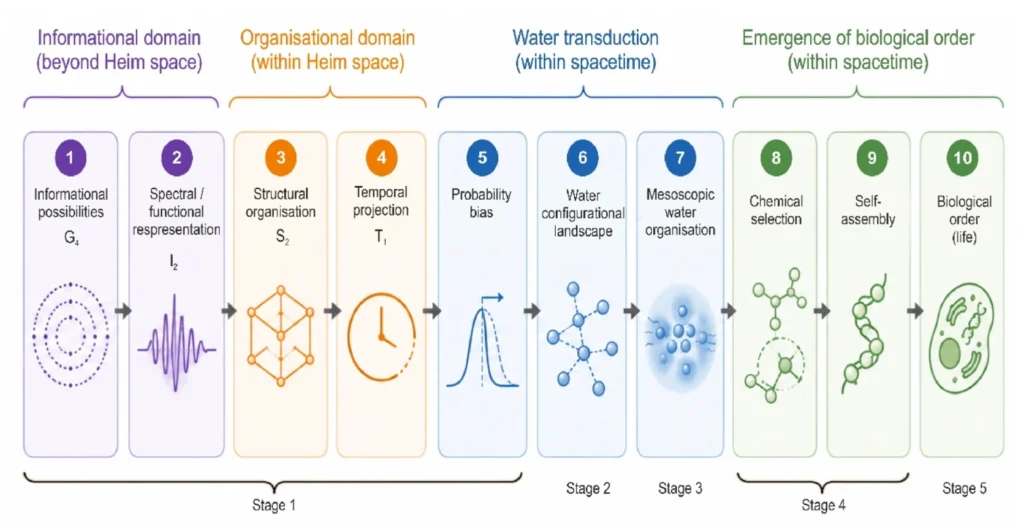
The proposed mechanism does not replace established chemical processes. Instead, it asks whether an additional ordering influence could modify their statistical development.
In this interpretation, water would neither store genetic information in the usual biological sense nor directly prescribe the complete structure of an organism. Rather, it would act as a dynamic medium capable of favoring certain chemical developments.
What Do the Experiments Show?
An important foundation of the paper is experimental research on water under unusual physical conditions, including electrically stressed water and the phenomenon of floating water bridges.
Such investigations demonstrate that liquid water can exhibit collective motion, modified vibrational properties, and mesoscopic organizational phenomena under suitable external conditions.
To interpret some of these effects, the authors also discuss quantum electrodynamical models of collective water dynamics, including theoretically proposed coherent domains.
An important distinction must be maintained: Observable collective phenomena in water do not automatically demonstrate Heim’s proposed projection mechanism. The specific interpretation of these observations through QED coherence models also remains an area of scientific investigation.
The publication is therefore explicitly presented as a hypothesis paper. Its contribution is to formulate a possible connection between theoretical ordering processes, experimentally accessible water physics, and prebiotic chemistry.
The Origin of Life in a Broader Scientific Context
Origin-of-life research already includes several powerful approaches.
RNA-world hypotheses explore the early relationship between molecular information and catalytic activity. Metabolism-first models investigate self-supporting chemical reaction networks. Research on lipid membranes and protocells examines how chemical systems could become compartmentalized and functionally integrated.
Non-equilibrium thermodynamics provides further mechanisms through which ordered structures can arise spontaneously in continuously driven systems.
Fuchs and Paulitsch-Fuchs present their approach as a possible complement to these frameworks. Their particular focus is on how chemical possibilities might become recurrent and functionally significant patterns of organization.
This question connects modern origin-of-life research with Heim’s broader investigation of organization, information, and temporal development.
Evolution, Syntrometry, and the Unity of Living Systems
Heim’s investigations extend far beyond the first living cell. His writings also address biological evolution, organismic integration, the organization of populations, and transitions toward more complex living forms.
Concepts such as entelechy and hierarchically structured networks of interactions play an important role in these investigations. Heim sought to understand changes in living systems not only as changes in material composition but also as transformations of organizational structure.
His historical evolutionary models must be distinguished from present-day evolutionary genetics and paleontology. Their particular significance for understanding his work lies in their attempt to address organization and development across different levels.
In Syntrometry, Heim attempts to develop more general concepts for describing structured relationships and their transformations. Terms such as Syntrix, Corporator, and Metroplex belong to this wider formal program.
A long-term research objective is to determine whether and how these concepts can be developed into precise and testable models of biological organization.
The philosophical work of Hedwig Conrad-Martius, particularly her investigations of entelechy and the self-organization of nature, also belongs to the broader intellectual context of these questions.
Open Research Questions
The relationship between Heim’s original theoretical program and the new water hypothesis suggests several research directions:
- Can the proposed rheomorphic probability bias be formulated mathematically so that it produces predictions distinguishable from known physical effects?
- Which collective states of liquid water can be measured reproducibly under controlled conditions?
- Can such states influence reaction probabilities or molecular self-organization in prebiotically relevant systems?
- How might short-lived patterns of dynamic organization become stabilized in persistent chemical structures?
- What additional principles would be required to connect chemical self-organization with metabolism, heredity, and systems capable of evolutionary development?
The central challenge is to transform an interesting structural interpretation into specific and experimentally testable predictions.
Literature and Further Reading
Burkhard Heim – The Elementary Process of Life (Der Elementarprozess des Lebens)
Included in Mensch und Welt, Resch Verlag, 2012 edition, pp. 73–138. Particularly relevant are the discussions of biological organization, heredity, carbon chemistry, and water as a reaction medium.
Burkhard Heim – Structures of the Physical World and Its Nonmaterial Aspect
With contributions by Walter Dröscher, Resch Verlag, 2007 edition. Particularly the introduction and chapters on hyperspace dynamics and projection processes.
Burkhard Heim – Berlin Lectures
Historical lectures and discussions addressing physics, biological evolution, living processes, organization, and the limits of quantitative description. Explore the archive.
Burkhard Heim – Syntrometric Maximentelezentrik
Part A: Syntrometry; Part B: Anthropomorphic Syntrometry. Introduction to Syntrometry.
Elmar C. Fuchs and Astrid H. Paulitsch-Fuchs (2026)
Water as a transducer layer between hyperspatial information and biological order: A hypothesis on the origin of life. BioSystems 269, 105951. Original publication.
Additional historical documents and contemporary research publications are available in the Heim Theory Archive.
The question of life thus leads to one of the broadest ambitions of Burkhard Heim’s work: to develop an understanding of reality in which physical processes, biological organization, and the further phenomena of conscious experience can be investigated in relation to one another.

