
What Significance Do the Findings of Modern Physics Have for Medicine?
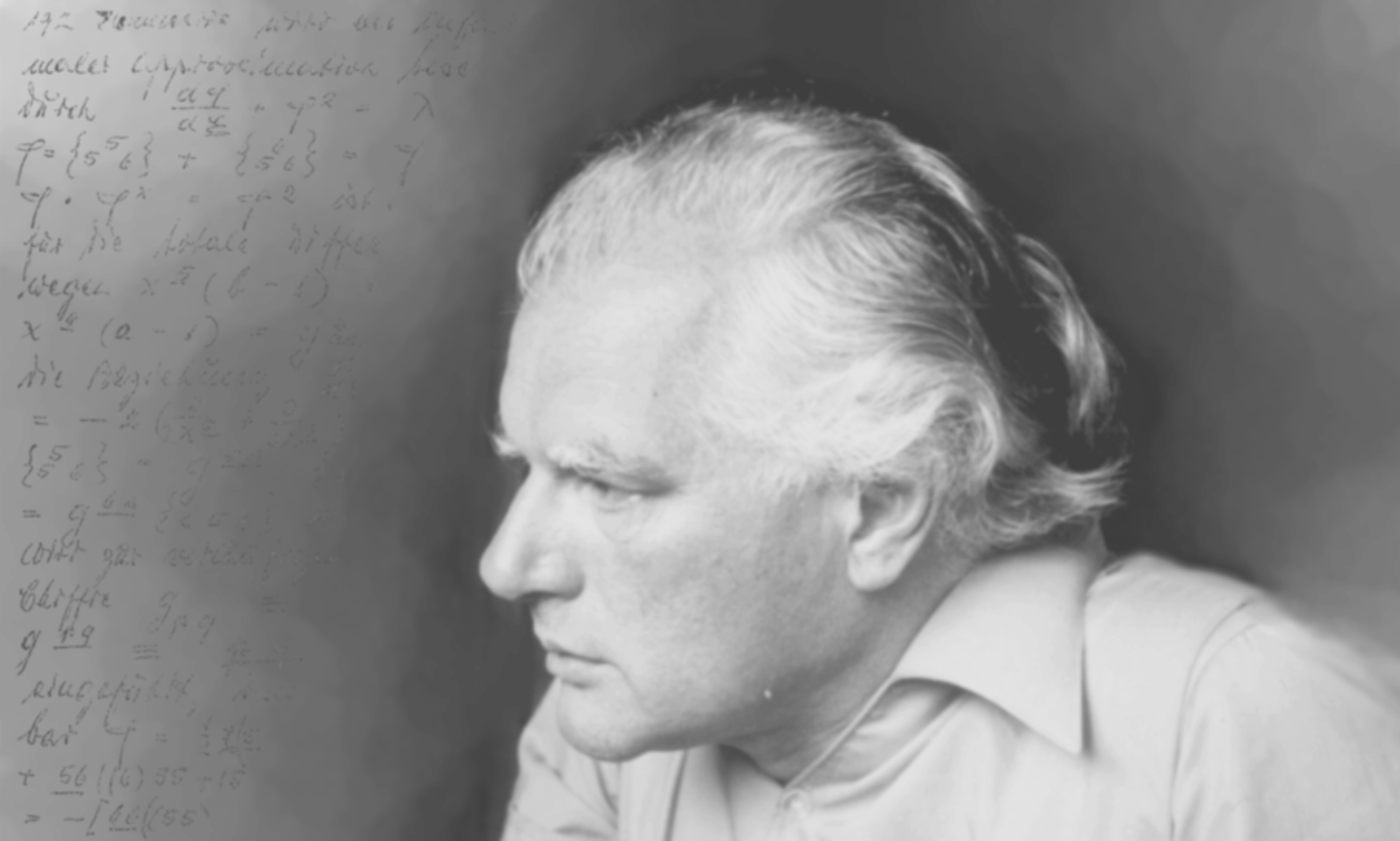
On June 9, 1993, Burkhard Heim delivered a lecture at the former Steglitz University Hospital in Berlin to members of the Berlin Wilhelm Reich Society. The audience consisted of approximately 30 participants, predominantly from medical backgrounds.
The approximately 90-minute lecture was recorded on audiocassette and subsequently transcribed. It provides a direct insight into Heim’s thinking and represents a particularly interesting spoken presentation of his extended conception of reality.
Beginning with the foundations of modern physics, Heim develops his ideas concerning the geometrical structure of matter, the existence of additional dimensions, and the relationship between information, organization, and physical processes. In the final part, he turns to the origin of life, biological evolution, and the question of whether living systems can be completely explained through physical laws.
Overview of the Lecture
Reality, Experience, and Human Knowledge
Heim begins by distinguishing reality itself from the reality accessible to human experience. Not everything that exists must be directly perceptible to human senses. While physical events can be described quantitatively, qualitative experiences, psychological phenomena, and consciousness also form part of human reality.
This distinction leads him to examine the limitations of mathematical descriptions of nature and the relationship between different domains of scientific knowledge.
The Geometrical Structure of Matter
Heim then outlines the foundations of his unified field theory, discussing conservation principles, the quantum of action, fundamental interactions, and the limitations of treating spacetime as a continuum.
His approach leads toward a quantized geometrical structure of the material world. Through his dimension law, Heim proposes that four-dimensional spacetime forms part of a six-dimensional structure, which is itself embedded in a twelve-dimensional framework.
Hyperspace, Information, and Probability
An important part of the lecture concerns Heim’s interpretation of the additional dimensions. He distinguishes physical space, time, organizational coordinates, informational coordinates, and a further domain that cannot be directly interpreted in ordinary physical terms.
He describes a sequence of projections through which structures associated with a nonmaterial background could become effective in physical events through informational and organizational intermediate stages. Heim connects this proposed hyperspace dynamics with his interpretation of quantum-mechanical probabilities.
The Origin of Life and Biological Evolution
In the final section, Heim examines how living organization might have emerged from nonliving matter. He distinguishes the formation of organic molecules from the more demanding problem of generating a functional, self-maintaining, and reproducing system.
His discussion includes prebiotic chemistry, the importance of water, genetic information, biological organization, and evolutionary development.
This section illustrates the broader ambition of Heim’s theoretical program: physical descriptions of matter should provide a foundation for scientific understanding without prematurely reducing life and subjective experience to exclusively quantitative relations.
Original Audio Recordings
The following recordings document the Berlin-Steglitz lecture of June 9, 1993.
Part 1a – Lecture (approximately 51 minutes german)
Part 1b – Continuation (approximately 41 minutes german)
Transcript (german)
A complete German-language transcript of the surviving recording is available. The transcription was checked against the historical audio recordings and corrected by Olaf Posdzech in 2014. A short passage is missing at the transition between the two recording segments.
Burkhard Heim – Berlin-Steglitz Lecture 1993 (Download German PDF)
Significance of the Lecture
The Berlin-Steglitz lecture is particularly valuable because Heim presents the connection between his physical theory and the broader questions of his worldview in a continuous and comparatively accessible manner.
It illustrates how Heim understood the transition from physics to biology and to the qualitative dimensions of human experience. At the same time, it documents the state of his research and the unresolved questions of his theoretical program in 1993. The more speculative proposals should be understood as elements of that program rather than experimentally established results.
The lecture provides a valuable complement to his 1976 MBB lecture and the more extensive Berlin lectures of 1994.

