
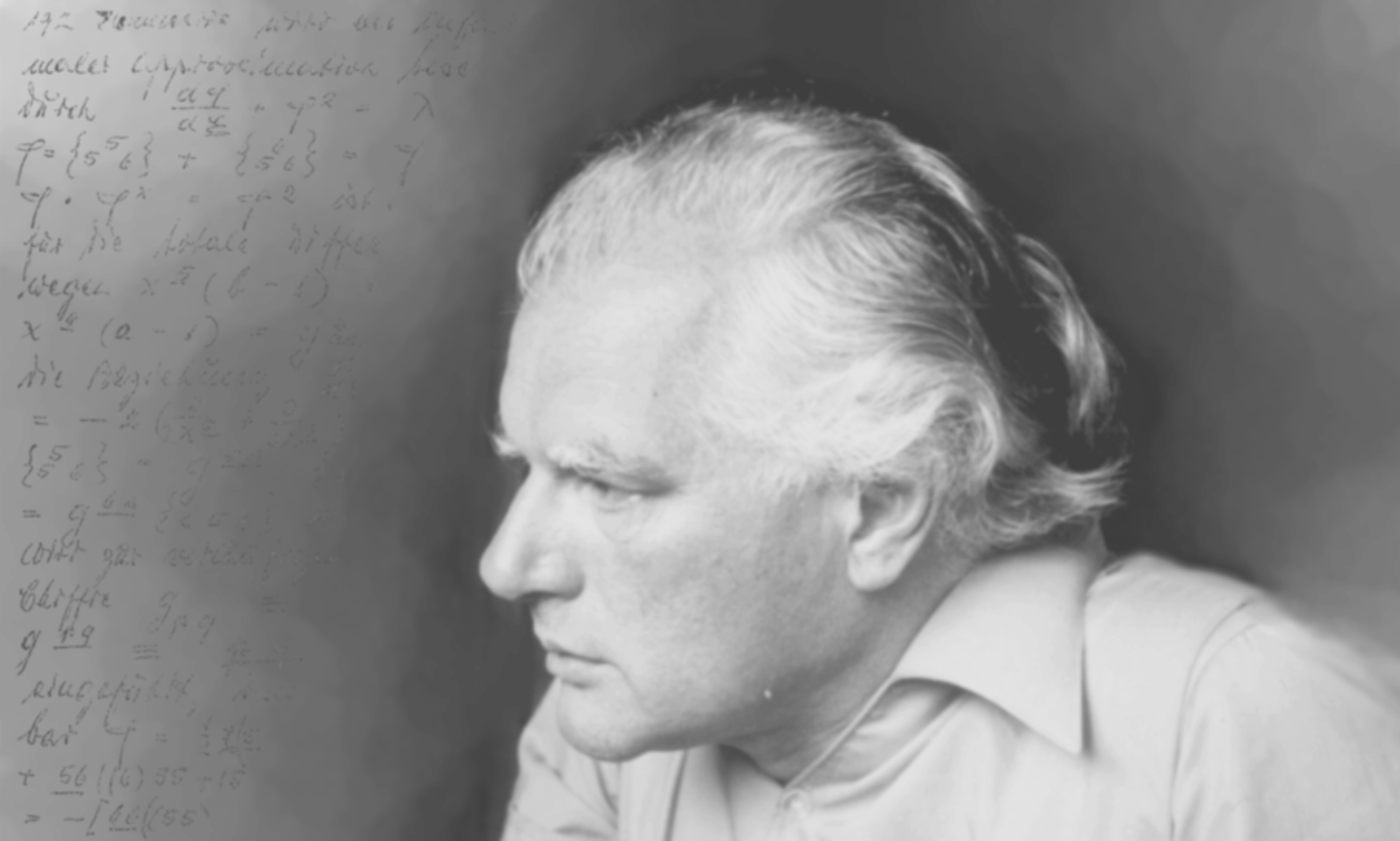
Burkhard Heim does not understand science as a mere accumulation of empirical data, nor as a purely technical manipulation of formulas. For him, science is the methodical attempt to infer, from the connected field of appearances, those sustaining structures by virtue of which events become intelligible as coherent, lawful, and knowable at all. It is therefore not only measurement, but insight into order; not only description of what is given, but penetration into the structural conditions that underlie it.
From this perspective, mathematics receives its special dignity. Heim stresses that the manifest material external world is given in the form of events that can be fixed by spatial and temporal determinations. Wherever an occurrence becomes quantifiable in this way, the human intellect possesses its sharpest criteria, and there mathematical method finds its proper domain. Mathematics is thus not merely a useful instrument, but the most precise expression of the aspect of quantity under which the physical external world becomes accessible to strict science.
Yet Heim does not stop at this high estimation of mathematics. Precisely because it is so effective, he asks after its presuppositions. The human intellect is not, for him, simply the measure of all possible knowledge, but a particular anthropomorphically determined mode of apprehension. Its expression is the bi-valued, predicative, contradictory logic of comparison: positive and negative, equal and unequal, greater and smaller. This logic is unavoidable and fruitful for human science, but it must not be identified without remainder with the structure of reality itself. It is, first of all, the structural expression of the specifically anthropomorphic intellect.
It is precisely here that Heim begins with syntrometry. Its point of departure is the insight that both aesthetic empiricism and the anthropomorphic transcendental aesthetics derived from it remain bound to the particular structure of our powers of perception and thought. For that reason, antagonisms arise within description: individual phenomena appear separated from one another, or even mutually opposed, while their abstract correlates remain concealed. Heim does not see this merely as a defect of observation, but as an indication that the very form of cognition must itself become an object of methodical reflection.
Syntrometry therefore means a reflexive abstraction from anthropomorphic logic and from the transcendental aesthetics bound to it. It is meant to lead toward a more universal methodology no longer tied from the outset to the particular structure of the human intellect. Heim is not seeking a departure from precision, but a deepening of it: not only statements about the world, but also the conditions under which such statements are formed, are to become transparent. Syntrometry is therefore not a counterpart to mathematics, but an attempt to lay open the domain within which mathematics, predication, and aspect-related description first receive their place.
At the same time, Heim remains strikingly sober in method. He explicitly distinguishes between two classes of events: the manifest events of the material external world, which can be quantitatively fixed, and the virtual or qualitative events of inner experience, which elude such access. This distinction is not a depreciation of the inner domain, but a methodological delimitation. Because mathematical method yields its sharpest criteria within the aspect of quantity, strict natural science must begin with manifest, quantitatively describable events. Yet this very fact also makes clear that the reach of mathematical description must not be confused with the full extent of reality as such.
Heim’s scientific program is therefore marked by a distinctive double movement. On the one hand, it demands the utmost mathematical rigor in the sphere of the measurable. On the other hand, it calls for methodological reflection on the aspect-bound character of every statement. Science must be able to calculate, but it must also give account of the aspect under which it calculates. It must formulate laws, but it must also recognize the domain of validity of those laws and the conditioned nature of its own mode of expression. It is precisely here that the real depth of the syntrometric approach becomes visible.
For Heim Theory, this leads to a demanding notion of unity. Unity is not achieved merely by subsuming different phenomena under a common formula. Genuine unity requires that the conditions of comparing, judging, and describing themselves be included in reflection. Mathematics, logic, and ontology therefore belong together in Heim’s work. His physics seeks not only to state structures of matter, but to uncover the path by which valid structural statements become possible at all. In this respect, syntrometry is the most general expression of his scientific program.

